Sixty Joyless De-Britished Uncrowned Commonpoor Years (1949-2009)

Elizabeth II Vice-Regal Saint: Remembering Paul Comtois (1895–1966), Lt.-Governor of Québec
Britannic Inheritance: Britain's proud legacy. What legacy will America leave?
English Debate: Daniel Hannan revels in making mince meat of Gordon Brown
Crazy Canucks: British MP banned from Canada on national security grounds
Happy St. Patrick's: Will Ireland ever return to the Commonwealth?
Voyage Through the Commonwealth: World cruise around the faded bits of pink.
No Queen for the Green: The Green Party of Canada votes to dispense with monarchy.
"Sir Edward Kennedy": The Queen has awarded the senator an honorary Knighthood.
President Obama: Hates Britain, but is keen to meet the Queen?
The Princess Royal: Princess Anne "outstanding" in Australia.
H.M.S. Victory: In 1744, 1000 sailors went down with a cargo of gold.
Queen's Commonwealth: Britain is letting the Commonwealth die.
Justice Kirby: His support for monarchy almost lost him appointment to High Court
Royal Military Academy: Sandhurst abolishes the Apostles' Creed.
Air Marshal Alec Maisner, R.I.P. Half Polish, half German and 100% British.
Cherie Blair: Not a vain, self regarding, shallow thinking viper after all.
Harry Potter: Celebrated rich kid thinks the Royals should not be celebrated
The Royal Jelly: A new king has been coronated, and his subjects are in a merry mood
Victoria Cross: Australian TROOPER MARK DONALDSON awarded the VC
Godless Buses: Royal Navy veteran, Ron Heather, refuses to drive his bus
Labour's Class War: To expunge those with the slightest pretensions to gentility
100 Top English Novels of All Time: The Essential Fictional Library
BIG BEN: Celebrating 150 Years of the Clock Tower

Wednesday, 31 December 2008

"With emotion, to the man I used to be"

Emile_Verhaeren01
Emile Verhaeren (1855-1916)

THE PROUD TOWER built up through the great age of European civilization was an edifice of grandeur and passion, of riches and beauty and dark cellars. Its inhabitants lived, as compared to a later time, with more self-reliance, more confidence, more hope; greater magnificence, extravagance and elegance; more careless ease, more gaiety, more pleasure in each other's company and conversation, more injustice and hypocrisy, more misery and want, more sentiment including false sentiment, less sufferance of mediocrity, more dignity in work, more delight in nature, more zest. The Old World had much that has since been lost, whatever may have been gained. Looking back on it from 1915, Emile Verhaeren, the Belgian socialist poet, dedicated his pages, "With emotion, to the man I used to be."

— Barbara Tuchman, The Proud Tower, A Portrait of the World before the War

Theo_van_Rysselberghe-_A_Reading_by_Emile_Verhaeren
A Reading by Emile Verhaeren (1903) - Emile Verhaeren as seen from the back in his red jacket


Read the full article >>

Tuesday, 30 December 2008

The Strength of the Monarchy is Faith

Belief, Conviction, it has many names, but I shall call it Faith for the purposes of this article. The point I intend to make is that faith is the strength of Monarchy and a Monarch's subjects, and the lack of faith in... anything really, the country least of all, is what leads to the sorry state of affairs in republics such as the troubled US of A.

A Monarch is a representation, a symbol, of the Nation, much like a flag. Except far superior to a mere flag, which is a point that has already been made in previous articles here at the Monarchist. In the ideal monarchy, the citizens of the nation have faith in their Monarch, and vice versa. Since the Monarch is a representation of the country, faith in him or her becomes patriotic fervour. Patriotism lends strength to the country. Let us examine, for example, how the patriotism of Britain in the first half of the 20th century allowed that great kingdom to weather the strains of two world wars successfully. One may consider the Soviet Union of those times to also be a monarchy, albeit a non-lineal, autocratic, communist, absolute monarchy, not at all the constitutional monarchy that we at the Monarchist support. Still, the faith that the people had in their ruler became patriotism, which led the Soviet Union to victory on the Eastern Front of the Second World War. An earlier British example would be the patriotism of British citizens during the Seven Years War and Napoleonic Wars, a patriotic fire which became turned the Royal Navy and British Army of those times into an indomitable fighting force. Patriotism is a strong force indeed, a force to be reckoned with, and when it comes to inspiring patriotism, none do it better than a monarch, and none have done it better than a British monarch. In the golden age of Britain's empire, the Victorian era, when a soldier was to be sent to the Sudan or any other unattractive colonial posts, he would not ask himself "What does that stretch of desert have to do with Britain?", he would ask himself "What does that stretch of desert have to do with Her Majesty the Queen?". Many decades later, in the dark days of the First World War, it was King, God and Empire that motivated the British and Commonwealth soldiers on the front.

Now, i'm not suggesting that blind and dogmatic nationalism should be the dominant emotion of every loyal subject of Her Majesty. The right to question your government is a hallmark of a developed, free society. However, the distinction must be made between Government and State. In the United Kingdom, and the Commonwealth countries who base their government upon the Westminster system, Her Majesty is Head of State, and a Prime Minister is Head of Government. Case in point: Her Majesty Elizabeth II and the Right Honourable Gordon Brown. All British citizens have the right to question the government of Mr. Brown if they see fit. However, despite being able to question government, all British citizens (certain odious republicans, europhiles and immigrant radicals notwithstanding) love and revere Her Majesty the Queen. Because the Queen is the living symbol of the United Kingdom, she inspires patriotism in her subjects, strengthening the country as a whole. And with the position of Head of Government seperate from Head of State, British citizens may still question their elected officials, elect new officials, etcetera, etcetera. But not out of personal dislike or selfish concerns, as you see in some modern republics where politicians strive for the female vote, the youth vote, the ethnic vote, etcetera. In a Commonwealth Realm, at least as I have experienced it, one votes out of love for the country, out of believing truly that this will be the best thing for the country, not because the politician supports legislature that is best for you. In an ideal world, what is best for the country is best for the Queen, and vice versa, and people would vote as such. Unfortunately, we do not live in an ideal world and thus we get odious republicans like Mr. Dennis Skinner elected to Parliament.

Now what happens when the Head of Government and Head of State are combined into one office, as in America? Well, sometimes things work out for the better. Oftentimes, you get figures like George W. Bush, who has made the Presidency an object of ridicule for the eight years of his term. Perhaps Mr. Obama will restore some reverence to the office, that remains to be seen. But I digress, when the Head of State is an object of ridicule, the country itself is an object of ridicule. Patriotism declines, and the strength of the country's people declines with it. People are the lifeblood of nations, and patriotism is the immune system which protects the blood from malicious outer forces. When there is no faith in the Head of State, the country is as a person who has lost his immune system to disease. Weak, fragile, sickly. And the lack of faith in the country spreads to other things. People start to think things like "Well if we can't believe in our country, what can we believe in?". Some become bitter cynics, others turn to cults, many fill the void with pop culture and celebrity worship. It ends up weakening the country as a whole. Even on their worst days, people still have faith and reverence in Her Majesty and the Royal Family, and thus in their country, and that is why Britain has, historically, been one of the strongest and most resilient of countries. Britain did not succumb to the republicanism of the 19th century, the nationalist seperatism of the Teens, the communism of the Twenties, the fascism of the Thirties and Forties, and none of the world wars that happened in that span. Why? Because faith in the monarchy was the strength of the Empire, and is the strength of the Commonwealth. As long as that is maintained, the Commonwealth will endure.

God Save the Queen and the Maple Leaf Forever!
-Gladstone


Read the full article >>

Sunday, 28 December 2008

Saturday, 27 December 2008

Dublin (In the Rare Old Times)

dublinunionjackSackville (now O’Connell) Street, Dublin, United Kingdom of Great Britain & Ireland.

Stolen from Andrew Cusack. Although probably authentic, it appears that an identical image has been vandalised of its true Britishness, no doubt some mildly depraved Irish nationalist removed the Union Flags from this photo in a pathetic attempt to rewrite one of the most glorious episodes of Dublin's history.

It is of course plausible that the opposite is true, that the image above is the one that has been doctored by some overly eager Irish Tory who wanted to embellish its imperial splendour. If true, let me be the first to say that there is absolutely nothing wrong with that kind of tampering.


Read the full article >>

Friday, 26 December 2008

Grooming the Future King


Read the full article >>

Positively Edwardian

Hair to the throne. A bearded, pheasant shooting Prince in the future mould of an Edward VII or a George V is perfectly fine by me. Bring back the old British kings!

Harry_Shoot


Read the full article >>

Thursday, 25 December 2008

Wednesday, 24 December 2008

Old Father Christmas

Jolly old Saint Nick is as old as the Reformation. Today's merry old Santa came about as an allegorical response to joyless Puritans who condemned Christmas celebration as "trappings of popery" and the "rags of the Beast."

morrissey_-_father_christmasWhen England's Puritan rulers banned Christmas in 1647, pro-Christmas rioting broke out in several cities, and for weeks Canterbury was controlled by the rioters, who decorated doorways with holly and shouted royalist slogans. The Restoration of Charles II in 1660 ended the ban, but many clergymen still disapproved of Christmas celebration.

The symbolic personification of Christmas as a merry old figure began as resistance to Puritan criticism of observing the annual Christmas feast. He is "old" because of the antiquity of the feast itself, which its defenders saw as a good old Christian custom that should be kept. Allegory was popular at the time, and so "old Christmas" was given a voice to protest his exclusion, along with the form of a rambunctious, jolly old man.

In the British tradition, he was referred to as "Sir Christmas" or "Lord Christmas" during the Victorian era. Today he is affectionately known as Father Christmas.


Read the full article >>

Saturday, 20 December 2008

The First Royal Christmas Broadcast

With a hoarse voice as if roughened by weather, King George V delivered the first Royal Christmas Broadcast - written by author and poet Rudyard Kipling - from a study at Sandringham House, Norfolk, on Christmas Day 1932.

The text, of timeless simplicity, bore the hallmark of the master: "I speak now from my home and from my heart to you all; to men and women so cut off by the snows, the desert, or the sea, that only voices out of the air can reach them."

In emphatic tones and the accent of an Edwardian country gentleman, it sufficed to carry his words to world-wide acclaim. With its very first delivery, the Christmas broadcast from Sandringham had become an institution.

Legend has it that the King used a gold microphone. It was in fact a standard one encased in Australian walnut. A thick cloth covered the table to deaden the sound of rustling paper, for the King's hands were known to tremble with nervousness. He spoke from a little room under the stairs: "I broadcast a short message of 251 words to the whole Empire from Francis' room."

Although moved by its reception, the King had no wish to repeat his triumph. It was an ordeal, he complained, which spoilt his Christmas. Some of his courtiers also thought (correctly, as it turns out) that an annual broadcast would lose its impact through familiarity. The politicians were of course encouraging, even if the King was unimpressed.

He agreed to continue only when shown a batch of appreciative letters throughout the Empire. The broadcasts of 1933, 1934 and 1935 never quite achieved the sublime appeal of 1932; perhaps the replacement of Kipling by Archbishop Lang as the principal draftsman exchanged magic for mere eloquence. Yet all who gathered year after year for the King's Christmas message awaited the voice of a friend.

Source: King George V, by biographer Kenneth Rose.

Photo © Press Association


Read the full article >>

Thursday, 18 December 2008

Stand Up for Royal Prerogatives!

In these pages we are concerned with the British Crown Commonwealth.

Occasionally, however, arises a situation that seemingly has nothing to do with the British Crown Commonwealth. Such a situation is the situation in the Grand Duchy of Luxembourg, where the Grand Duke stood up on grounds of conscience against a new euthanasia bill.

The Parliament of the Grand Duchy swiftly acted to vote on a constitutional amendment to change the Grand Duke's power from that of assenting or sanctioning to that of promulgation. We hear, however, that there must be another vote in a few months, either in Parliament or in a referendum.

The situation is sadly a likely scenario of what might happen were the Commonwealth Sovereign to stand up against the will of politicians.

It is the Grand Duke of Luxembourg this time. It may be the Commonwealth Sovereign next time.

There is a petition, where apparently persons of all nations are welcome.

So if one values the Royal Prerogatives, signing the petition, with an optional personal message, in support of the Grand Duke would certainly be a right thing to do. Supporting regal privileges in other realms may give much needed support for the concept of regal privileges as such, which in turn may give support for the concept in the Commonwealth Realms.

Remember also that Queen Victoria was the grandmother of Europe.


Read the full article >>

Sunday, 14 December 2008

The Powers of the Crown – Satisfactory?

The so-called crisis in Her Britannic Majesty's Kingdom of Canada has been described as a situation where the choice was between two evils. Either the Governor General had to do as advised – block the popular will as expressed through Parliament, by prorogation – or refuse to do as advised by an elected official.

The Parliamentary Mace of Western Australia
I'll leave the specifics of this situation to others, making more general comments here on the two main issues of principle; whether advice should be automatically heeded or not and whether a parliament should be suspended or not.

Let us have a look at the assertion that advice given must be followed. This is largely based on Walter Bagehot's three rights; the rights to warn, to encourage, and to be consulted. In addition, the case is made for so-called reserve rights, rights only exercised in emergencies, from time to time.

We will examine the assumption that the Crown must remain above politics. There is first of all a difference between being above politics and being above party politics. Also, there is a difference between being above politics and being above day-to-day politics. And perhaps above all, there is a difference between being above and ejected to irrelevance. We need to remember what the preposition above means. It says something about who or what is above whom or what. Being above and being totally sidelined are two very different things. One cannot be above and sidelined at the same time.

We so often hear that the Crown should remain politically neutral. However, there is also the issue of having a check on Parliament, and even on the popular majority. Any balancing act against the will of Parliament or the will of the popular majority will necessarily not be politically neutral. It may be political party neutral, but it will never be politically neutral. You cannot have an office as a check on democracy and politically neutral at the same time. You cannot have your cake and eat it too.

The concept that the Crown must only act upon the advice of elected politicos reduces the Crown to a rubber-stamping machine. If the Crown is to be a rubber-stamping machine, it would be appropriate to ask what the point of monarchy is.

It can be argued that the rights of the monarch are there to prevent the “advisors” from coming with indecent advice. However, if assent is taken for granted, one could wonder if there is any such prevention at all.

Of course, there is the issue of emergencies. If you really have a machine, this machine would consent also in the most severe emergencies, wheras a monarch or its representative may not. It is, however, tempting to ask if we ever will encounter an emergency severe enough for royal intervention to occur. It is more probable that our liberty will continue to be nibbled away, for expedience, and by parts, to paraphrase the great Edmund Burke.

We should have a look at what this month has happened in the Grand Duchy of Luxembourg. The Grand Duke refused to give his assent to a new euthanasia bill. The politicos, headed by the PM, promptly responded that the Grand Duke's role would be changed from assenting or sanctioning to promulgating. The PM was himself opposed to the euthanasia bill, but now a “more important” cause was at stake; the will of Parliament.

From time to time, we hear nice and fancy speeches along the lines that “democracy must be something more than majority rule.” We also hear the talk of constitutional democracy being a form of government where the will of the majority is limited. However, when a real check on the will of Parliament is exercised, that check is debunked, and we hear that nothing may stand in the way of the will of Parliament.

The Parliament in Luxembourg has reportedly acted swiftly. The constitutional amendment was passed reportedly this passed week. It took less than two weeks from the constitutional conflict arose to the politicos had passed the constitutional amendment. We have been told that debate on important issues is something we should allow time for. However, when parliamentary power is threatened there seems to be no limit to how little time there is.

The story in Luxembourg may serve as a scenario for what will happen were the Crown in a Commonwealth Realm ever to intervene in a similar way. Remember though, that scenarios are not certainty. Another scenario is that the Crown continues the policy of total non-intervention for decades – or even for another century and more – and people get even more accustomed to the concept that the Crown is a decoration.

The story in Luxembourg may also serve as an illustration of how far we in this world have come when it comes to unlimited democracy. Nothing must stand in the way of a popularly elected parliament. Nothing must stand in the way of the popular majority. It is sad.

Some people say that the Governor General of Canada did no wrong, but that it was Stephen Harper who gave the wrong advice. Advice is just that, advice. As we have established, it is a sad state of affairs where “advice” becomes verdict – where the Crown is ejected to irrelevance.

Now for the issue of prorogation. Situations do arise when there is a need for a monarch or a viceroy to tell the politicos to pull themselves together. When monarchs or viceroys do this, they are much criticized, but their doing so is still much needed. If parliamentarians decide one thing one week, and then turn around and decide the opposite the next, sending them on leave is perhaps not such a bad idea. We can think of other things also that are not so bad ideas in such a situation either.

Here we take issue though with something a bit beyond merely telling politicos to pull themselves together.

Yours truly often longs for the times when parliaments sat only a few weeks a year, and perhaps they didn't even meet every year. The federal Parliament in Switzerland is still like this, meeting only a few weeks a year.

When people complain about politicos having longer vacations than the regular people, we should respond that it is a good thing with longer vacations for politicos. When they're on vacation, they don't get to pass lots of new legislation.

We should rejoice when a parliament is suspended. There should be more of it. Of course, if Parliament has a secretariat that is not suspended, the suspension isn't as effective as it otherwise might be.

We have grown accustomed to parliaments and other legislatures meeting most of the year.

We should keep in mind what Judge Gideon J. Tucker told us:

No man's life, liberty, or property are safe while the legislature is in session.
The thinkers that warned about the effects of unbridled democracy are many. Amongst them were Sir James Fitzjames Stephen, Alexis de Tocqueville, and W.E.H. Lecky. Edmund Burke wrote of tyrannical democracy. So have many others. When we see that they were right, we should take their warnings seriously.

We have grown accustomed to popularly elected assemblies as always present, and we are told – and most of us believe – that they are guarantors of our freedom. Yet government interferes in our lives, homes, and businesses to an ever increasing level, not to mention to a degree foreign to most – if not all – monarchs of old. As the power of parliaments and legislatures has risen, the power of monarchs has declined. Declined also has our liberty.

We mark this year 320 years since the so-called “Glorious Revolution.” In these 320 years, democracy has far from delivered on its promise of liberty.

The right to vote is what is supposed to protect us. Yet, liberty is nibbled away anyway. We are told that the individual vote gives the individual influence. Yet, no one asserts that an individual right to pour a bucket of water into Lake Superior gives the individual influence.

If parliaments didn't meet so often, if their suspension was not so uncommon, and if the parliamentary will couldn't be taken for granted, it is likely that this world would be a better place.


Read the full article >>

Tuesday, 9 December 2008

400 years of John Milton (1608-1674)

...he was a true Poet, and of the Devil's party without knowing it.
- William Blake on Milton's Paradise Lost.

John Milton was born 400 years ago today, on December 9, 1608. If Oliver Cromwell is English history's most famous republican, John Milton must be regarded as England's most famous republican poet. Samuel Johnson called him that "acrimonious and surly republican" for his dangerous commitment to the English Revolution and his continuing unpopular attacks against Royalists right up to the time of the Restoration. Milton was very much a political, social and religious radical for his time, who fought for oligarchical government over absolute monarchy, who supported legal measures for divorce and polygamy, who rejected the Holy Trinity of the Bible and believed in mortalism over the divinity of Christ. He forthrightly hated the High Church, he hated the Lords and he hated the natural power of Kings. He was the very opposite of a Cavalier Poet.

Two weeks after the execution of Charles I in 1649, Milton committed himself to the Republican side by publishing The Tenure of Kings and Magistrates in support of the regicide. His argument (which runs in direct opposition to Hobbes' Leviathan published in 1651), was that a monarch's power is not absolute, but derived from the people he rules and held in accordance with a social contract. If a monarch breaks this contract by abusing his position, the people have the right to remove him from power. Not exactly radical stuff by the standards of today.

Milton joins hands with John Locke as an early apostle of liberalism who fought against the absolutist monarchist writings of Robert Filmer and Thomas Hobbes. His last major pamplet published in 1660 was an anti-monarchical protest in the face of the coming Restoration, which expresses a feeling of despair at seeing his countrymen so eager to run back to servitude. Milton seemed to think that it was better to reign in Hell than serve in Heaven, but there is also a real sense of the man as a lone but stalwart adherent to a greater truth rebelling against a false authority. "The work is an impassioned, bitter, and futile jeremiad damning the English people for backsliding from the cause of liberty and advocating the establishment of an authoritarian rule by an elitist, unelected parliament." Perhaps fearing the tyranny of the many in addition to the tyranny of the one, he favoured not a democratic solution but a perpetual Rump Parliament, a kind of governing council with a permanent ruling membership. Unfortunately the modern word Politburo comes to mind, but to Milton this was The Ready and Easy Way to Establish a Free Commonwealth.

Milton's view of monarchy and the decadence of monarchy is a theme later emphasized in Paradise Lost. Within this epic, Milton's magnus opus, Satan is directly linked to monarchical rule. The tone of the piece is to ensure that the citizenry would not backslide into their old monarchical ways. In particularly, Milton relied on predictions of the future combined with biblical analogies to ensure that people knew the dangers inherent in such a governmental system. In particular, Milton argued that it would be a sin against God to bring back the monarchy and warned against the lack of freedom and virtue that would correspond with a king.

How stunned Milton would be 400 years after his birth to learn that freedom and virtue wear a Crown.


Read the full article >>

Sunday, 7 December 2008

The fall of Helengrad

I'm not sure why we failed to mention that New Zealand has a new prime minister, but the Honourable John Key nows heads up the other Down Under. Like so many others who are wedded to the spirit of the age, he reportedly believes that it is inevitable (yawn) that New Zealand will become a republic, so I'm not sure how much of an improvement this limosine liberal is over his predecessor. In any event, unlike his colleague across the Tasman, he had the dignified good sense not to raise the republican issue in advance of meeting Her Majesty a couple of weeks ago. (Notice also how his tie matches Her Majesty's dress!)

Insight%20nov08%20gallery%20zeal%20largeThe Queen receives the Prime Minister of New Zealand, the Hon. John Key MP, at Buckingham Palace, 25 November 2008.
© Press Association


Read the full article >>

Saturday, 6 December 2008

Stephen Harper: Traitor to the Dominion

Now, I know that many of you here will have a good deal of respect for the so-called Right Honourable Stephen Harper, but let me say this: I have lost the respect I had for the Prime Minister. Allow me to elaborate.

I'm sure many of you are familiar with the political drama occuring in the Elder Dominion these days. For those of you who aren't, allow me to sum it up: A coalition has formed of the Liberals, the NDP and the Bloc Quebecois, in unison declaring that the minority Conservative government of Mr. Stephen Harper no longer has the confidence of Parliament. The coalition wishes to put forward a non-confidence motion and if it passes, which it probably will, Stephen Harper will be forced to call an election, which he probably will lose against the Coalition of the Left. Why? Because of the Bloc Quebecois. Quebec, as i'm sure all of you know, is a pretty big, pretty populous, pretty important province in the Canadian electorate. Stephen Harper has never been able to build a political base there, mostly because of the dug-in Bloc Quebecois, which tailors specifically to Quebecois concerns on a national scale, especially seperatist/sovereigntist sentiments (exploring those two terms is another topic entirely). The Governor-General, doing her duty, intervened and prorogued Parliament, basically giving the two immensely angry sides a time-out to cool their tempers.

So how is Mr. Stephen Harper using this time-out? Why inciting hatred against the Bloc, of course. He's been portraying the Liberal-NDP-Bloc coalition as a 'deal with the Devil', Conservatives across the country have been calling the Bloc 'seperatist scum', basically he's just been trying to turn English Canada against French Canada. Why? You may ask? Because Stephen Harper is hungry for a parliamentary majority, and Quebec is the one bastion that he will never overthrow. So his solution? Simply remove them from the equation. If his cunning little campaign of hate works, the Quebecois will feel alienated, will feel that L'Anglais hate them, and if the Bloc calls another referendum, they WILL seperate. And with Quebec out of the picture, that's 75 seats in Parliament gone right there. The loss of those 75 seats means that Parliament will be reduced to 233 seats... and the Conservatives control 143, a strong majority. To sum this up, Stephen Harper will divide up this country, which has stood united for over a hundred years, just to claw his way up on the pecking order.

THAT, ladies and gentlemen, is why Mr. Stephen Harper has lost my respect! Any man with true loyalty and devotion to this Dominion would not divide the country just to further his own power. I think it must be said: Stephen Harper is an underhanded traitor to the Elder Dominion for resorting to such dishonourable and undemocratic means just to further his own power. It is not the will of Her Majesty the Queen for Quebec to seperate from Canada, and the majority of Canadians do not want it either. I certainly don't. And what kind of example does it set to the world if Quebec seperates and Canada is divided? To much of the world, we are the city on the hill, the example of peace, prosperity and unity to follow. What is next if Quebec and Canada part ways? Will Scotland leave the United Kingdom next? Will Northern Ireland and Wales go as well? Will all the great old empires and states be divided up by damnable nationalists, convinced that their petty differences are matters of life and death? This is exactly the kind of thinking that led to the powderkeg of the Balkans, and we are all well acquainted with what the Balkans caused in 1914.

If you continue as you do, Mr. Harper, perhaps you will gain your precious majority, but you will live on through out history as the great betrayer of Queen and Commonwealth, the man who divided up the Elder Dominion, Canada's Benedict Arnold.

God Save the Queen and the Maple Leaf Forever!
-Gladstone


Read the full article >>

The Queen's Speech


Read the full article >>

Friday, 5 December 2008

Why the Governor General was right.

It’s over: the day, the decision, the crisis, the coalition, and Stephane Dion’s leadership. After the abortive putsch — constitutional as it may have been — the field is strewn with bodies, and the bloodletting has just begun.
- Andrew Coyne on the end of the crisis, the Governor General's decision and the impending death of the Coalition.

I applaud the Governor General and her wise counsel on her decision to prorogue Parliament and to give its Members a badly needed time-out. In my judgement, she picked the least worst of two very bad options, and she should be commended for doing what was required to defend the neutrality and dignity of her office. Make no mistake about it, on the face of it this sets an awful precedent, of backing a prime minister and his ministry on the run from the will of Parliament. But she demonstrated considerable prudence - perhaps even courage - for the following reasons:

1. Parliament expressed a degree of confidence in the Conservative government when it passed the Throne Speech last week. I say again, last week.

2. The current government was elected seven weeks ago with a stronger minority. In a five party/leader race, Stephen Harper won 143 of 308 seats and 37% of the vote, compared to just 77 seats and 26% of the vote for Stephane Dion's Liberals. The Liberal leader received no mandate to be prime minister.

3. Granted you should never govern based on polls, but there are polls and then there are polls. Polls now indicate that had it been a two leader race, one between Harper's Conservatives and a Dion led coalition of the Left, the Conservatives would have won a comfortable majority of the seats with a commanding 20 point lead in the popular vote, something like 47% to 24%. Canadians do not like it.

4. Had the GG thrown out the Conservatives and installed the rickety Coalition in government, the populace would have goaded for her removal or even worse, brought our whole parliamentary monarchy into disrepute.

5. The GG showed a small degree of courage in her home province of Quebec by not handing a share of power to the Bloc Quebecois. Although she stands to gain by completely dispelling any notion that she's in league with the Quebec sovereigntists (an issue that came up just prior to her appointment by the Queen), this will not be a popular move in much of la belle province.

6. Granting power to the Coalition would have fanned the flames of national disunity. It would have pitted Quebec against the rest of Canada, especially Western Canada.

7. Removing the Conservatives from power would have enraged the West. I'm not talking about anger here, I'm talking spiteful, seething and spitting rage.

8. The Coalition is an inherently unstable and factionous thing led by an unusually weak leader, who may have not lasted past Christmas. The Coalition is deeply unpopular with the country partly because it appears like a naked grab for power so soon after an election. Having installed such a fragile edifice, the Governor General would have received a share of the inevitable blame that would arise as a result of the Coalition's failure to properly and responsibly govern the nation.

9. The Conservatives will still have to face the music in January, only this time on a more substantive issue, like the expected federal budget. If they lose the confidence of the House then, the Coalition should be given an opportunity to govern. This is not a cop-out, it's a time-out. A badly needed time-out.

10. As a result of all of the above, few are questioning the political neutrality of the Crown. Our Queen has been saved. God Save The Queen.

Update: Andrew Coyne says it better than I can on the merciful death of the Coalition


Read the full article >>

Thursday, 4 December 2008

Over to You, Your Majesty

T'WAS THE NIGHTMARE BEFORE CHRISTMAS, and all through the House, not a creature was stirring, except Dion the mouse. It is amazing how such an enfeebled Liberal leader, who got so thoroughly trounced in the federal election held barely six weeks ago because Canadians did not want him as prime minister, stands to become Prime Minister of Canada nonetheless if Governor General Michaëlle Jean refuses Prime Minister Harper's formal request this morning to prematurely prorogue Parliament; a request made for no other reason than for the current government to avoid facing a non-confidence vote they would very likely lose. This is a technical abuse of the British Parliamentary system.

And now the Queen's representative has been put in a very tricky political situation, because to deny the wish of a sitting prime minister is as unpalatable as granting it, of overseeing a transition to power to a man who just lost the election, who so clearly lacks the democratic legitimacy to lead the country. Yet Stephane Dion apparently has the confidence of the House through behind-the-scenes coalition dealing with the three leftist/left-leaning opposition parties, who combined have about a dozen more seats than the ruling Conservatives. How did Harper so badly miscalculate their weaknesses, how did he not see that the Liberal leader far from being weak, had nothing to lose after losing an election so badly, one that forces him to vacate the Liberal throne once a new leader is chosen. How did he not see that the social democrats and their leader would sign on to anything and with anybody who would promise to waste billions in an utterly futile "economic stimulus" package. And how did he not see that the Quebec nationalists/sovereigntists/separatists/socialists (take your pick) would support any spending measure that would see the dole role into Quebec by the truckload. Harper is an evil genius alright, we know he was able to singlehandedly unite the Right, and now he has shown an equally remarkable aptitude for uniting the Left.

To sum up, every federal party leader in this political crisis has egg on their face for dragging the Queen into this unbelievable mess. The pundits go on about some perceived "constitutional crisis", but let's be clear: there is no crisis here that the Crown cannot referee or solve. A decision simply needs to be made by Her Majesty's representative, and that is that. She wields an incredibly awesome power right now, contrary to the constant assertions of republicans, the Crown is not some useless instrument that should be discarded, but an abolutely necessary and critical part of our government. We are witnessing just how critical it still is today.


Read the full article >>

Monday, 1 December 2008

A Team of Three

The Monarchist League of New Zealand has a wonderful new website: Monarchy New Zealand. One of their pages caught my attention, which I think should be used more often to bolster the argument that our countries are better constituted than all of the world's modern republican states.

All countries have a "head of state" and a "head of government". In some political systems the president is the head of state and the head of government. In other countries, the two roles are separated. Sometimes the head of state is a president, but in all constitutional monarchies, the head of state is the monarch. The head of government is the Prime Minister. He or she is elected by the people and controls day to day government operations. This separation of powers is designed to prevent one person from having too much power.
New Zealand is fortunate because, as a Commonwealth Realm, it has a Governor-General. The Governor-General is neither head of government nor head of state. Often he or she is referred to as the "de facto head of state" which means that he or she operates like a head of state, but isn't legally one. Because we have a Governor-General, we can divide political power between three people, instead of just two.

The Governor-General can keep watch over the Prime Minister to ensure he or she is not attempting anything illegal. The Queen can keep an eye on both to make sure they are doing their jobs. Fortunately, the system works so well that there have been very few cases where the Queen or a Governor-General needed to take action to stop a prime minister from abusing power. It has happened before in other countries, and if it happens here in the future, kiwis can be confident that their democracy is safer in the hands of three people than in the hands of one or two.

New Zealand and the other Commonwealth Realms (except Britain) are the only countries in the world which divide their highest political powers between three people. This arrangement has made our democracy much stronger. To concentrate the powers of three people into the hands of two would be a fundamental change in our political system and would take us down a road that has not be very successful in many other countries.

One is good, two is better, three is best!


Read the full article >>

Sunday, 30 November 2008

The Imperial State Crown

Her Majesty the Queen gives a talk on the Imperial State Crown.


Read the full article >>

Wednesday, 26 November 2008

A Whig's Perspective

Good day to all you fine, discerning gentleman and ladies here at the Monarchist. I am a new scribe here, and I have written this article as a way of introducing myself. You may call me Gladstone. Not only that, but I would like to introduce my beliefs in this article, so that none of you excellent Tories will be surprised by my decidedly Whig perspective.

I am a Progressive, a Leftist, a Liberal, and a Whig. With all that, you'd expect that I'd be firmly against Her Majesty the Queen, correct?

No. No, I am a most loyal Canadian subject of Her Majesty the Queen. In fact, I sing God Save the Queen every day while going about my morning routine. I have been this way since a young age (though some would argue I am still at a young age, but I digress). If I could have Red Ensign bed sheets, I probably would. If I could change the Canadian anthem from the overly neutral O Canada to the more patriotic Maple Leaf Forever, of course I would. I love Her Majesty, and I love my English heritage, and I love my Canadian homeland, and I love this great British Commonwealth of which we all belong.

So how is this so? You will find many Whigs these days to be odious republicans (The political belief, not the American political party, of course). Hopelessly idealistic egalitarians, or staunch democrats who can't stand the mere idea of having a dignified part of government, set above the unwashed masses. The heirs of Woodrow Wilson, the Great Idealist himself. Many of them are just Dennis Skinner-type working class buffoons with no reverence for the Crown that has lasted for nearly a thousand years. Proletariats rising against their, quote-unquote, “oppressors”, Marx would be proud. On a related note, Dennis Skinner is one of my all-time most hated MP's ever. I will tell you why. It's because, despite my leftism, I am a proud and unabashed elitist. As the eloquent scribes here at the Monarchist put it: “Equality be damned!”

Oh, I am no racist, nor sexist, nor homophobic. My elite is not based on things that do not matters, not based on things a person has no control over. The noblesse, to me, are those who strive to do better than their peers. And we will always have those people, who elevate themselves and their families above the unwashed masses. Hereditary titles, like the noble Peerage of the United Kingdom, are continuing honouring of a man's deeds, by acknowledging those descent from him. Her Majesty, our fount of honour, is a living acknowledgement of William the Conqueror's prowess and ambition. That is my elite, not based on any race, gender or sexual preference, but on your quality and that of those who came before you. Is that elitist? Indeed so, and I embrace it.

This is why I support Her Majesty and the House of Windsor. They are the dignity of Britain and it's Commonwealth. In addition to the great services they provide as a national symbol (far superior to any mere flag), a unifying force, as diplomats, in the case of the Princes, soldiers, and the historic British championing of minority rights, they are the source, the fount of honour, of dignity in government. Pomp and splendour, they lend magnificence to matters of government. Can anyone truly compare a Presidential inauguration motorcade to Her Majesty's coronation? I think not. The pros they provide far outweigh the cons, or the possible pros of discarding them. Some other nations tell us to 'grow up' and force Her Majesty to abdicate. How is it grown up to reject a magnificent tradition? Is the mindless rebellion of an angry teenager throwing a fit against his or her parents 'grown up'? Most would say no. Then why is it grown up to discard a tradition that has done nothing but good for Britain and the Commonwealth? I say: God Save our Queen, God preserve the Windsors, and the Maple Leaf Forever!

-Gladstone


Read the full article >>

Sunday, 23 November 2008

The Wrinkles of Centuries

While reading J.K. Baltzersen's post on Queen Maud of Norway, as well as noticing that rather striking portrait of our future sovereign in the headers celebrating his 60th birthday, I began to ponder the question of dynasty. Victor Hugo, who was himself a republican but not overtly hostile to crowned institutions, observed in Les Miserables:

But it is not always easy to create a dynasty. At a pinch any man of genius, or even any soldier of fortune may be made into a king. Bonaparte is an instance of the first, and an instance of the second is Iturbide, the Mexican general who was proclaimed emperor, deposed in 1823, and shot the following year. But not any family can be established as a dynasty. For this some depth of ancestry is needed: the wrinkles of centuries cannot be improvised.
I am a monarchist by tradition. It is the tradition of my country, Canada, to have a monarchy. Historically monarchies have been more stable and humane institutions than their republican competitors, the only really successful republics in history are the Roman, the Swiss, the Dutch (which is today a monarchy) and the American. Most republics have been disasters. The French Republic - now on version 5.0 - survived into the second half of the twentieth century largely because of the efforts of one man, Charles de Gaulle, whom many called an uncrowned king in his dozen years as President. Why are most republics such spectacular failures? The modern world affords many examples of stable democratic republics, South Korean, Germany, Italy, Portugal, Greece and most of the states of Eastern Europe. Notice, however, that none of these republics have strong liberal democratic traditions dating before 1945, most were dictatorships of one variety or another as late as the 1970s or 1980s. None, importantly, have faced a grave military or economic crisis and should - forbid the thought - the world undergo another Great Depression I cannot see many standing for very long.

The period between 1929 and 1932 signalled the end of what has been called the first era of globalization, it was also the end of the first era of global liberalism, in the broad and original understanding of that word. Poverty and crisis overwhelmed the feeble republics of Europe and Latin America. Among the republican states only Switzerland, France - barely - and America survived. The stability of the House of Windsor, and the houses of Scandinavia, were never questioned. The secret is not, I think, really monarchy but something we sometimes miss here at the Monarchist, dynasty. Lloyd George, no friend of the peerage or the crown, once remarked about the House of Lords:

There are no credentials. They do not even need a medical certificate. They need not be sound either in body or mind. They only require a certificate of birth just to prove that they were the first of the litter. You would not choose a spaniel on those principles.
Too clever by half, as Lloyd George often was. The first of the litter doesn't seem an inspired method of selection, and it goes as much for monarchs as for peers. Yet it works well. An inherited position, especially of great wealth, mitigates corruption or ambition. A politician has the perspective of a few years between elections, and he is always fund raising. A monarch, or one in waiting as Prince Charles, must take the perspective of centuries. Unlike private wealth, which may come without responsibility, the wealth and glory of a monarch in a modern liberal democracy does not. The Queen and the Prince of Wales are among the hardest working people in the United Kingdom, enduring a schedule as brutal as that of many cabinet ministers or top executives. To whom much is given, much is expected.

It instills a sense of duty and public service, in the older meanings of those words. Today duty is seen as a thankless task performed with reluctance. Public service a code word for subservience to an over mighty state. No sane man would wish to be King, but having been placed in that line of fate, awesome even in a constitutional state, the opportunity to make an impact on the world is still great. It is this perspective, the wrinkles of centuries, that gives a monarchy its flavour and grandeur. To have lasted so long does not guarantee goodness, but it suggests that an institution has spoken to some deep desire and need of the human race. We ignore this truth at our peril. Those eager to replace the House of Windsor, and the personal union of Her Majesty's 16 Commonwealth realms, with some kind of crowned republic are pursuing an, at best, foolish, and often dishonest strategy. Crowned republic is another way of saying republic later. Any soldier of fortune can be made a king, or in our more stable times any patronage appointment can be made a king.

We too, in Canada, Australia and New Zealand can have some bloodless head of state like Italy or Israel, a nonentity plucked from obscurity to shake hands with foreign diplomats, a figure too weak and irrelevant to challenge an overly ambitious minister of state. A monarch like our current sovereign is not crossed lightly. She has seen too much and been enough away from the fray of politics, a detached and largely impartial observer, not to have learned much. We do not know what she thinks. We are fairly certain she was no fan of Mrs Thatcher, but very much liked Mr Wilson and Mr Major. Yet government worked as smoothly as ever. It was headlines when the Queen was alleged to have reprimanded Mrs Thatcher for being "uncaring," yet Thatcher could not - whatever the rightness of her cause - ignore the crown with impunity. Even a constitutional monarch who reigns more than rules, provides a valuable check on the power of her ministers. A monarch who was made a monarch by chance, by political whim or election, is a feather in the breeze. A dynasty is something not to be trifled with.

The Gods of the Copybook Headings


Read the full article >>

Thursday, 20 November 2008

In Memory of Maud of Wales

It was November 26, 1869. A Princess was born to Prince Albert Edward, the Prince of Wales, later Edward VII, and Princess Alexandra, the Princess of Wales. The newborn Princess was Maud Charlotte Mary Victoria of Wales.

Maud of WalesAs such she was a granddaughter of Queen Victoria, the grandmother of Europe. It was a time when non-morganatic marriage was not only the norm, but a strict norm. Archduke Franz Ferdinand, who saw his last day in Sarajevo on June 28, 1914, could not let the throne pass to his children with his consort Sophie, who was only of aristocratic blood. She was a mere noblewoman. It was a time when royals marrying consorts of the lowest order – with “pasts” – was unthinkable, save for the most extremely vivid imaginations.

Princess Maud of Wales was born in the year Royal Assent was given to annual ordinary sittings of Parliament in the country she was to become Queen Consort. In the year she turned two years old, annual sittings came into effect. Previously, ordinary sittings had been every third year. She was born before parliamentary government was very much an issue in the country she was to become Queen Consort.

On July 22, 1896 Princess Maud of Wales married Prince Carl of Denmark. On July 2, 1903 the marriage was blessed with Prince Alexander – later Crown Prince Olav and King Olav V of Norway.

It was in an age when dissolved unions and independence gave states that sought kings of their own. It was in an age when the default form of government was monarchy. It was in an age when nations that sought to establish a form of government sought to establish a monarchy. It was in an age when the revolutionary republic was the only republic besides the ancient republic of the Helvetic Confederation among the major states of Europe. The revolutionary republic was looked upon with suspicion, and rightly so.

The powers of Europe, the revolutionary republic included, wanted Norway to retain her monarchy.

It was time when the ancient Kingdom of Norway, so often erroneously referred to as a new monarchy, sought a King of her own.

There was a referendum on whether to consent to the Norwegian Parliament – the Storthing – inviting Prince Carl of Denmark to ascend the vacant, ancient throne of St. Olav. This referendum is so often referred to as a referendum over the issue of monarchy vs. republic. 79 % consented to make Prince Carl King, and thus to make Princess Maud Queen Consort of Norway.

Prince Carl was proclaimed King on November 18, 1905, upon which Princess Maud became Queen Consort of Norway. Having taken the name Haakon VII, the new King came with his Queen Consort and Crown Prince Olav on a cold winter day, November 25, 1905, to the Norwegian capital of Christiania.

The Danish Prince had been selected to ascend the throne of St. Olav due in large part to his status as son-in-law of His Britannic Majesty King Edward VII. Building an alliance through relations of one's royalty was important. Such was this age.

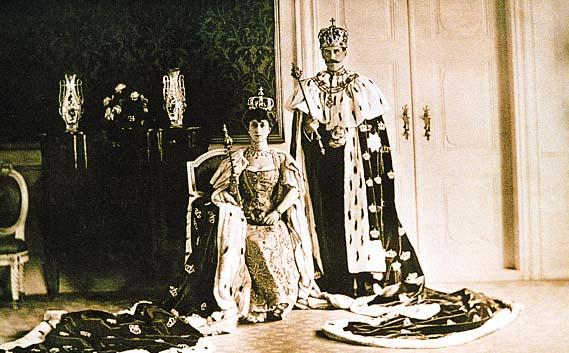
King Haakon and Queen Maud were crowned in Trondhjem on June 22, 1906. A post-coronation photo taken in the local royal residence with robes and regalia reportedly prompted His Britannic Majesty to report back that his daughter and son-in-law suited the outfits well. In the wake of the coronation, the King and Queen traveled their Kingdom. In the city of Haugesund the dessert Queen Maud Pudding was composed to His Britannic Majesty's daughter's honor. The dessert is popular at weddings and other occasions till this day.

Coronation of Their Majesties King Haakon VII and Queen MaudWhilst accepting popular sovereignty, whilst being much less publicly confrontational than his predecessor, King Oscar II, whilst seeing himself as significantly less a power in his own right than his predecessor, King Haakon VII did have ambitions of being something else than a marionette of the politicos. There was a struggle. His Majesty once commented that a handkerchief was something he was allowed to poke his nose in. By his side was Queen Maud.

The republican politicos who brought the new King and his Consort, Maud of Wales, to the land had other plans than the country to remain a monarchy. They wanted to use him as security in the beginning and later dump him for a republic. His Majesty was to reign for almost 52 years – well into the democratic republican age.

Queen Maud visited the land of her birth quite often. She attended the latest coronation of a King in Westminster Abbey, that of His Britannic Majesty King George VI, Her Majesty Queen Maud's nephew. That was to be her last public appearance in the United Kingdom. She passed on on November 20, 1938, 70 years ago today, less than 17 months too early to be at King Haakon VII's side when his Kingdom suffered the consequence of the politicos not following Majestic advice about defense level.

Queen Maud is laid to rest with King Haakon VII, who survived his consort with almost 19 years, in the Royal Crypt in Oslo.

The widower King Haakon VII boarded HMS Devonshire on June 7, 1940, bound for London, which was to be the capital of the Kingdom of Norway for just about five years. The King, with few exceptions, met with and chaired his Cabinet every Friday for about five years in what was then the official Royal seat, the Royal Norwegian Embassy, today's Ambassador's residence, close to Kensington Palace.

The Norwegian Government today has this historic building in its possesion, but has let the Cabinet offices from the WWII years go.

As an uncle-in-law of His Britannic Majesty, King Haakon stayed mostly at Windsor Castle. His Majesty's 70th birthday was celebrated in Royal Albert Hall. His Majesty served as a symbol of liberation through the war years, and his voice was welcomed on all the "illegal" radios around the occupied land. King Haakon's popularity outclassed what was thought of the politicians who served as his Cabinet Secretaries. At the end of the war, there were voices speaking up for more regal powers, notably that of Johan Scharffenberg, a man who had pushed for a republic back in 1905.

Queen Maud Land in the Antarctic is the largest Antarctic claim, a Norwegian dependency. It was recognized by the United Kingdom and His Britannic Majesty's dominions of Australia and New Zealand.

Queen Maud Mountains in Antarctica are also named after Maud of Wales. So is Queen Maud Gulf in Nunavut in Her Britannic Majesty's Kingdom of Canada. There is also the Queen Maud Secondary School in Hong Kong.

Maud of Wales may have had a back seat in history compared to King Haakon VII. However, without Maud of Wales there probably would not have been a King Haakon VII, and we certainly would not have had King Olav V, whose subject yours truly was born.

The relations between the House of Windsor and the House of Norway are stressed from time to time, realtions which make yours truly a subject of a great-grandchild of Edward VII.

We honor the memory of Maud of Wales on this 70th anniversary of Her Majesty's passing.


Read the full article >>

Sunday, 16 November 2008

Ranch Republican or British Monarchy?

We remember the wars, the five trillion dollars in added American debt and the calamities that bookend the Dubya years. But the English-speaking gentleman did not truly become aghast until that unforgettable summer day in 2007 when Her Majesty came to Washington on one of her rare state visits to the Capitol.

How not to wear white tie, courtesy of George W. Bush:

1. The waistcoat should never extend below the bottom of the tailcoat.

2. The shirt collar must be a wing collar.

3. The trousers are to be worn at the waist, not slung down around the hips.

4. The shirt sleeve should have at least 3/4" of cuff.
(To be fair, Prince Philip is equally guilty of this particular faux pas, but you didn't read that at The Monarchist. By the way, what do you suppose our Grand Old Duke is thinking as he sets his eyes on Dubya?)

5. Also, avoid goofy laughter in the presence of Her Majesty The Queen.

From The Black Tie Guide, A Gentleman's Guide to Evening Dress. (Except for number five which is mine).


Read the full article >>

Wednesday, 12 November 2008

High Anthony

Did Drinamyl, a combination of amphetamines and barbiturates, destroy the British Empire? Or at the very least impair the judgment of its Prime Minister, during one of the gravest moments in British history? In a new book David Owen, a physician and one of the youngest foreign secretaries in history, traces the influence of illness in the personal judgment of various world leaders, including one of his predecessors, Sir Anthony Eden. Blessed with matinee idol good looks, a fine sartorial style and impeccable manners, Eden served three times as Foreign Secretary, and was Churchill's closest ally and lieutenant during his two terms as Prime Minister. Widely popular in the country, and generally respected as one of the century's most effective foreign secretaries, he succeeded Churchill as Prime Minister in April of 1955 with great promise; quickly calling and winning a snap election. In a little more than a year and a half he was out of office, forced out by ill-health and one of the greatest foreign policy blunders in the country's history.

Gamal Abdel Nasser, the opportunistic young military office who helped overthrow the Egyptian monarchy, only to then seize power for himself. Seeking to consolidate his power, both in Egypt and establish his credentials as the leader of the Arab world, he seized control of the Suez Canal. The proximate cause was the refusal by the American government to finance construction of the proposed Aswan Dam, later built with Soviet assistance. Nasser's long-term goal was the removal of British influence in the Middle East, replacing its near century long hegemony with an Egyptian one. Although built by French engineers, the majority of the shares were owned by the British government, thanks to the quick thinking of Disraeli and his friends in the Rothschild banking family during a financial crisis in 1875.

To Eden, who had resigned as Foreign Secretary in 1938, in part, because of Neville Chamberlain's policy of appeasement, Nasser was a latter day Mussolini and nationalization, something akin to the invasion of Ethiopia in 1935. President Eisenhower, and his usually bellicose Secretary of State John Foster Dulles, saw the Suez Crisis differently. Supporters, in principle, of decolonization and keen to supplant British influence in the oil rich region, the American government refused to support military action. It was at this moment that Eden, arguably, committed one of the gravest strategic errors ever made by a minister of the crown. Overestimating the importance of the special relationship in Eisenhower and Dulles calculations, and Britain's comparative economic strength, he launched a plan of subterfuge remarkable for both its scale and complexity.

British, French and Israeli representatives meet in secret at Sèvres, near Paris, and agreed that Israel should invade the Sinai. Using this as a pretext an Anglo-French force would invade and seize the canal, arguing that it was attempting to keep apart the warring parties. The protocols of Sevres, as they became known, recalled the Great Power deals of a different era, like the Sykes-Picot Agreement which divided the Middle East between Britain and France during World War One. 1956 was the era of the Superpowers; Britain and France were now firmly in the American orbit. The deception of Sevres was too convenient and complex not to be discovered. In a less democratic and, from geopolitical perspective, bi-polar world this might not have been a problem. Eisenhower, fearing a Soviet response and greatly annoyed for having been kept out of the loop by Eden, forced London and Paris to agree to a cease-fire and withdraw. Eden had gambled that Nasser's flirtation with the Soviets would compel Washington to accept, if none too happily, an Anglo-French fait acompli over Suez. Instead Eisenhower threatened to, literally, starve Britain into submission if it did not agree to an American cease-fire plan. Much of Britain's war debt was held by the American treasury, Eisenhower threatened to dump enough of this debt on world markets to force a collapse in the pound. A nation dependent on imports of food to survive, Britain would be unable to feed itself. Eden, from force majeure conceded and went to seek medical treatment.

During the tense months of Summer and Autumn 1956, Anthony Eden stood at the center of Anglo-French efforts to retake the Canal. Had he been able to persuade Eisenhower to, at the very least, not interfere in his efforts to undermine Nasser, there would have been no Suez Crisis as we understand it. The retaking of the Canal would have been a dramatic coup for Eden and Britain and probably would have broken Nasser's power. When an elected Persian government nationalized its oil industry, Britain responded by orchestrating a coup - in conjunction with the CIA. Having successful defied a major western power, something no Arab leader had done in centuries, Nasser became a regional hero and icon for decades. Emboldened by Egypt's success a wave of nationalizations swept the Middle East, granting the region's dictatorships a flood of oil wealth to sustain their regimes.

If the sin of Suez lies with Washington, for failing to support British efforts, the error of the crisis lies with Eden, for miscalculating American and, to a lesser extent, Commonwealth support. Neither proved willing to follow London's, and his, lead. Owen points to a medical reason for Eden's poor judgment, a combination of prescription drugs required to deal with a recurring infection, itself the result of a botched surgery to remove gallstones. A slip of a doctor's scalpel may have altered the course of history for the worse. The counter argument to this is that nothing, not even Eden's considerable powers of persuasion, could have convinced Eisenhower to support a military retaking of the Canal. He might, however, in the fashion for which Dulles brothers (John Foster's brother ran the CIA) were well-known even then, have orchestrated a coup against Nasser. The Egyptian dictator was extremely popular, but so was the Iranian government the CIA had overthrown less than three years earlier. Over the long-run, however, Eden looks the most prescient. If Nasser was no Mussolini in the making, the failure of will at Suez established a de facto policy of appeasement toward the Arab world. Two years after Suez the Iraqi monarchy, a British puppet, fell to an Army coup, a military regime was installed and later taken over by Saddam Hussein.

The Gods of the Copybook Headings


Read the full article >>

Tuesday, 11 November 2008

Armistice Day, 1918

1918Toronto_BayandKing_Armistace_Day

Armistice Day, 1918 at the Corner of Bay and King in the City of Toronto.
(click on the photo to enlarge)


Read the full article >>

Their Name Liveth Forevermore

At the 11th hour, the 11th day and the 11th month, the guns fell silent 90 years ago today. Abide With Me, O Valiant Hearts. At the going down of the sun and in the morning, we will remember them.

remembrance6


Read the full article >>

Saving the Aerodrome of Democracy

F.D.R called Canada the Aerodrome of Democracy for its massive undertaking and central responsibility for flight training of pilots and aircrew from all across the British Empire during the Second World War. Unfortunately we now learn that 447 Wing, the last of the so-called "H-huts", is facing the axe from its apparently ungrateful host.

h_hut500big"HAMILTON — Real Second World War history is a messy business, soaked with blood, sweat and countless spilled beers. And so it is at 447 Wing, also known as the last of the “H-huts.”

Here, at the edge of Hamilton Airport, you enter a time capsule where you can blink your eyes and find yourself in 1942. The bar rail is dented by boots that worked the rudder pedals of Spitfires and Lancasters, and the walls are hung with squadron insignias and photographs of young Princess Elizabeth.

The clientele is vintage too – some of the men who come here for a quiet drink have been regulars for close to 70 years..."


Read the full article >>

Monday, 10 November 2008

Reflections

(Linked from The Soaring Eagle)

I had some time to reflect on things today, and a passage from Shakespeare came to me: "Uneasy lies the head that wears the crown." It is a passage from Henry IV, in Part II, and possibly one of the most straightforward quotations of Shakespeare's work. Or so we assume, anyway.

I say this because I realized a deeper meaning while reflecting on this passage. Is the head uneasy because it wears the crown, or because of the typical symbolism of thereafter responsibility?

Most people would claim that it is a simple symbolism for the responsibility that a man at the top feels weighing down on him. However, that's an overly simplistic view of the situation. Every person feels weighed down with responsibilities, no matter their station in life. Rather, it seems to me that the true weight of the crown, the weight that makes the king feel uneasy, is rather the fact that he must do so alone.

The eagle that flies highest is always alone.

That simple realization made me reaffirm my commitment to the Monarchist cause, and indeed, it has made it all the stronger. Thanks to that reflection, I understand now that the real weight on the shoulders of the monarch is the fact that they have no one else to help them carry it. For that reason, I say now that no one who has not felt the despair of true loneliness has any right to criticize those who accept the weight for the sake of letting no one else have to go through it.

We often state the extensive media exposure of the Royal Family as a downside to their job, and indeed, that is true. However, perhaps it is also through that media exposure that we can understand just how alone they must feel. When the Queen, or any of her family for that matter, greet the people outside their lavish palaces, do they seem barely tolerant, or truly happy? When Prince Harry visits his charity projects, does he act cold and aloof (as one might suspect a pampered prince to behave), or does he interact with the children and look happy as he does?

Why is that happiness so apparent, we must ask. Kings and Queens have always had the unspoken right to be dismissive and aloof, but these princes and princesses seem to love the interaction with their people, more than they do the return trip to their palaces. What else could explain it but the joy of being recognized and thanked for their unspoken work? For carrying that burden of solitude most other people would be crushed under? I say again,

The eagle who flies highest is always alone.


Read the full article >>

Sunday, 9 November 2008

We Will Remember Them

A WAR FILM, by Teresa Hooley (b. 1888)

I saw,
With a catch of the breath and the heart’s uplifting,
Sorrow and pride,
‘The week’s great draw’ -
The Mons Retreat;
The ‘Old Contemptibles’ who fought, and died,
The horror and the anguish and the glory.

As in a dream,
Still hearing machine-guns rattle and shells scream,
I came out into the street.

When the day was done,
My little son
Wondered at bath-time why I kissed him so,
Naked upon my knee.
How could he know
The sudden terror that assaulted me?...
The body I had borne
Nine moons beneath my heart,
A part of me…
If, someday,
It should be taken away
To War. Tortured. Torn.
Slain.
Rotting in No Man’s Land, out in the rain -
My little son…
Yet all those men had mothers, every one.

How should he know
Why I kissed and kissed him, crooning his name?
He thought that I was daft.
He thought it was a game,
And laughed, and laughed.


Read the full article >>

Thought Showers Grip Bournemouth

The verbal Jacobins are at it again. The town council of Bournemouth, Dorset, has banned the use of Latin words and phrases in official documents and communications. There is no talk yet of changing the town motto, Pulchritudo et salubritas. Latin, says the local politicos, is a dead language that few can understand. This monumental bit of historical and cultural revisionism has caught the ire of many who, rightly, see it as an attempt to modernize away British heritage. So blatant and absurd is the policy that even the Daily Mail, scarcely the paper read by Oxbridge Dons, is opposing the policy with the headline: Si fractum non sit, noli id reficere

In a staggeringly philistine move, the council has just listed 19 Latin terms it no longer considers acceptable for use, including five of the expressions I used in the opening paragraph (see if you can spot them). Come to think of it, they probably wouldn't be very keen on the word philistine either - it comes from a Latin word, philistinus, which refers to an ancient tribe in Israel, who were considered particularly primitive. Not nearly as primitive as the idiots of Bournemouth Council, though. Every single one of the 19 terms they have banned have become so embedded in our language that they have, quite literally, become English. Yes, you will find vice versa, ad lib and bona fide in a Latin dictionary, but you will also find them in an English dictionary. Banning them is the same as banning English words - because that is precisely what they are.
I'm reminded of the Evelyn Waugh novel, Brideshead Revisited, where the main protagonist, Charles Ryder, reflects on the generation coming of age in 1945, in particular the hapless young Lt. Hooper.

Hooper was no romantic. He had not as a child ridden with Rupert's horse or sat among the camp fires at Xanthus-side; at the age when my eyes were dry to all save poetry - that stoic, redskin interlude which our schools introduce between the fast flowing tears of the child and the man - Hooper had wept often, but never for Henry's speech on St Crispin's day, nor for the epitaph at Thermopylae. The history they taught him had few battles in it but, instead, a profusion of detail about humane legislation and recent industrial change. Gallipoli, Balaclava, Quebec, Lepanto, Bannockburn, Roncevales, and Marathon - these, and the Battle in the West where Arthur fell, and a hundred such names whose trumpet-notes, even now in my sere and lawless state, called to me irresistibly across the intervening years with all the clarity and strength of boyhood, sounded in vain to Hooper.
It isn't that the Hoopers are in control, their grandchildren are in control. This is a bleaker prospect still than the one Waugh faced. There may have been "few battles" in Hooper's education but he had some exposure to traditional pre-1960s culture. The Drones of Bournemouth have no such advantage, or restraint. The council of Tunbridge Wells recently suggested banning the use of the phrase "brainstorm" because it might be offensive to people with epilepsy. I suspect only those who also suffer from a severe bout of modern education would object.

Crossposted at The Gods of the Copybook Headings


Read the full article >>

Saturday, 8 November 2008

Fox Hunting more Popular than Ever

More than 80 landowners, including the Duke of Norfolk, are to renew a legal attempt to ban hunt protesters from private estates.

More than 80 landowners, including the Duke of Norfolk, are to renew a legal attempt to ban hunt protesters from private estates.
Police are seeking greater access to hunts to prevent the four-year-old ban being flouted amid a surge of interest in the pursuit.

Since the ban came into force on 18 February 2005, the number of hunt members has increased by about 5,000, with about 50,000 regular riders, while the number of people watching the hunts has grown to 120,000. Total turnover of the hunts has grown from £155 million a year before the ban to at least £170 million.


The hounds are baying, the horses are stamping their hooves and the port is being passed around at Puckeridge Hunt. How's that, you ask?


Read the full article >>

Thursday, 6 November 2008

The Courageous Royal Gurkha Rifles

The Gurkhas earned their right to stay in Britain long ago, yet they were only granted this right recently. Better late than never I suppose.

Insight%20nov08%20gallery%20gurk%20largeMembers of the Gurkha Rifles display the Military Crosses presented to them by The Queen at an Investiture ceremony at Buckingham Palace, 4 November 2008. The soldiers were honoured for courageous service in Afghanistan.
© Press Association


Read the full article >>

Wednesday, 5 November 2008

His Mightiness Confounds

Well, some people aren't confounded. Besides the commenters, Peter Hitchens has some pretty strong views: The night we waved goodbye to America... our last best hope on Earth

barack-obama-5-14-08Now that Barack Hussein Obama has been democratically proclaimed His Mightiness Elect of the world, courtesy of the people of the United States, we should wonder how such a man managed to confound so many people, so many conservative-minded people.

When the supposedly Tory Mayor of London, Boris Johnson, enthusiastically endorses him we can chalk this up to be nothing more than pure political calculation (he is Mayor of London after all, how many Londoners were supporting McCain do you suppose?). But when a former Ronald Reagan speechwriter supports him because he believes him to be an honest to goodness Burkean, what is it about this man that confuses people?

Who is this man, anyways? Is he a progressive or a Burkean? Is he a Muslim or a Christian? Is he a hawk or a dove? Based on his parentage, can we even really say he is black or white? On almost any question, the man confounds.

There is one thing that everyone can agree upon, however, and that is his oratorical mastery. He is right up there with Martin Luther King and Malcolm X, the man can deliver a speech in the evangelical American tradition where such speech-giving has been historically cultivated.

Remember, we don't produce such men because we come from a different tradition, and have a completely different political culture. I don't think Obama's skills would shine through in Parliament, Westminsterism has a way of putting you in your place. In a politician's republic, there is nothing that puts you in your place. You have the ability to become something of a God to the masses. We are witnessing such a moment tonight.


Read the full article >>

Tuesday, 4 November 2008

Her Majesty Honours Canada's War Dead

Canada's high commissioner to the UK described the Queen's tribute in London as a touching moment. “It was extremely moving watching the names scroll down very slowly ... there was absolute silence,”

The Queen honoured Canada's war dead from the Great War today as a high-tech vigil paying tribute to some 68,000 fallen Canadians flickered onto a wall in London's celebrated Trafalgar Square.

The Duke of Edinburgh was also among those who gathered to watch the international debut of Vigile 1914-1918 Vigil, a Canadian-made dusk-to-dawn tribute that features a nightly display of the names of the fallen veterans.

The ceremony began with darkness falling on London amid the piercing notes of The Last Post, played by a lone bugler.

“Long may we all remember the multitude of Canadians, and indeed all of those who laid down their lives to defend the lives of others,” the Queen, a maple leaf brooch on her coat, told the crowd gathered at Canada House.


Read the full article >>

Monday, 3 November 2008

Anti-monarchist rant worthy of Monty Python

One more time with feeling...

"If there were Lunatic Asylums for Institutions, I have no doubt that ‘Megalomanic’ British Monarchy would have been sectioned, straight jacketed and incarcerated ages ago! The repellent tentacles of this rabid military backed British monster has, unopposed, plundered and polluted defenceless countries for centuries. This was evident during the merciless colonising and violent intervention of a voracious crusading Monarchical Britain, at a time when maps extolling British Empire pink showed wide subjugation of much of the world..."


Read the full article >>

Sunday, 2 November 2008

H.M.S. Hood: "the beauty, grace and immaculate strength of her"

HMS Hood 1924We note, belatedly, the death of Albert Edward Pryke "Ted" Briggs MBE, the last living survivor of the sinking of HMS Hood. Destroyed in tracking the Bismarck in May 1941, the Hood was the pride of the Royal Navy. Of its 1,418 crew only three survived. The story of signalman Briggs and the Hood, retold in countless books, films and TV documentaries, is also a love story. It was the chance sighting of HMS Hood, anchored off the river Tees at the age of 12, that charged the young lad with the idea of life at sea. Briggs later recalled "I stood on the beach for some considerable time, drinking in the beauty, grace and immaculate strength of her." As with generations of young boys before him, Briggs went to his local recruiting office, being told to come back when he was 15. A week after his 15th birthday he returned and was accepted. On June 29 1939 he joined HMS Hood's crew. "It never once occurred to me that she might be sunk," he said. "As far as I was concerned, she was invincible. And everybody on board shared this view."


Few in the Admiralty, and fewer among the officers and ratings, understood how air power had forever changed the nature of naval warfare. Visionaries, like the American General Billy Mitchell and Japan's Isoroku Yamamoto, had foretold the death of the great battleships. Hood was not, like her sister ship Prince Wales, destroyed by air assault. Instead, in one of naval history's luckiest shots, the Bismarck succeed in landing a shell precisely on the Hood's magazine, sinking the ship in minutes. For years complaints had been made about the thinness of Hood's deck armour, yet few would have imagine so specularly successful a shot in battle conditions. Through out the inter war years, Hood was launched in 1918, spent much of her time on goodwill visits. These were the years of the Treaty of Washington, a face saving deal between Britain, the United States and the other major naval powers. While nominally an arms limitation agreement, in truth it allowed the penny-pinching US Congress to cut back on naval spending, and allowed the Royal Navy the illusion of genuine parity with the Americans. Washington limited the size of both the USN and RN to parity in numbers and strength, a much needed relief for the strained post war Treasury. Finance would weaken the Royal Navy and her grand ships, but technology would make them museum pieces. The aircraft carrier, a British invention, transformed much of the world's great navies into seaborne aerial platforms. Yet there is still no shortage of boys like Ted Briggs, who dream of ships of immaculate beauty.


Read the full article >>

Saturday, 1 November 2008

Away from a European Republic


Wanted: More Lord Tebbitts. Hat Tip: His Grace, Archbishop Cranmer


Read the full article >>