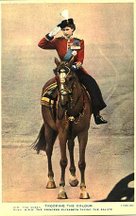
Sixty Joyless De-Britished Uncrowned Commonpoor Years (1949-2009)

Elizabeth II Vice-Regal Saint: Remembering Paul Comtois (1895–1966), Lt.-Governor of Québec
Britannic Inheritance: Britain's proud legacy. What legacy will America leave?
English Debate: Daniel Hannan revels in making mince meat of Gordon Brown
Crazy Canucks: British MP banned from Canada on national security grounds
Happy St. Patrick's: Will Ireland ever return to the Commonwealth?
Voyage Through the Commonwealth: World cruise around the faded bits of pink.
No Queen for the Green: The Green Party of Canada votes to dispense with monarchy.
"Sir Edward Kennedy": The Queen has awarded the senator an honorary Knighthood.
President Obama: Hates Britain, but is keen to meet the Queen?
The Princess Royal: Princess Anne "outstanding" in Australia.
H.M.S. Victory: In 1744, 1000 sailors went down with a cargo of gold.
Queen's Commonwealth: Britain is letting the Commonwealth die.
Justice Kirby: His support for monarchy almost lost him appointment to High Court
Royal Military Academy: Sandhurst abolishes the Apostles' Creed.
Air Marshal Alec Maisner, R.I.P. Half Polish, half German and 100% British.
Cherie Blair: Not a vain, self regarding, shallow thinking viper after all.
Harry Potter: Celebrated rich kid thinks the Royals should not be celebrated
The Royal Jelly: A new king has been coronated, and his subjects are in a merry mood
Victoria Cross: Australian TROOPER MARK DONALDSON awarded the VC
Godless Buses: Royal Navy veteran, Ron Heather, refuses to drive his bus
Labour's Class War: To expunge those with the slightest pretensions to gentility
100 Top English Novels of All Time: The Essential Fictional Library
BIG BEN: Celebrating 150 Years of the Clock Tower
Showing posts with label Constitution of Liberty. Show all posts

Wednesday, 14 January 2009

How did the anti-monarchist Nazi Party fair in the 1932 German federal election with monarchist friendly Catholics?


Percentage of Nazi Votes July 31, 1932

nsvotes2

Percentage of Catholics in Germany (census 1934)
cathpop2

Not very bloody good, as it turned out.


Read the full article >>

Thursday, 18 December 2008

Stand Up for Royal Prerogatives!

In these pages we are concerned with the British Crown Commonwealth.

Occasionally, however, arises a situation that seemingly has nothing to do with the British Crown Commonwealth. Such a situation is the situation in the Grand Duchy of Luxembourg, where the Grand Duke stood up on grounds of conscience against a new euthanasia bill.

The Parliament of the Grand Duchy swiftly acted to vote on a constitutional amendment to change the Grand Duke's power from that of assenting or sanctioning to that of promulgation. We hear, however, that there must be another vote in a few months, either in Parliament or in a referendum.

The situation is sadly a likely scenario of what might happen were the Commonwealth Sovereign to stand up against the will of politicians.

It is the Grand Duke of Luxembourg this time. It may be the Commonwealth Sovereign next time.

There is a petition, where apparently persons of all nations are welcome.

So if one values the Royal Prerogatives, signing the petition, with an optional personal message, in support of the Grand Duke would certainly be a right thing to do. Supporting regal privileges in other realms may give much needed support for the concept of regal privileges as such, which in turn may give support for the concept in the Commonwealth Realms.

Remember also that Queen Victoria was the grandmother of Europe.


Read the full article >>

Sunday, 14 December 2008

The Powers of the Crown – Satisfactory?

The so-called crisis in Her Britannic Majesty's Kingdom of Canada has been described as a situation where the choice was between two evils. Either the Governor General had to do as advised – block the popular will as expressed through Parliament, by prorogation – or refuse to do as advised by an elected official.

The Parliamentary Mace of Western Australia
I'll leave the specifics of this situation to others, making more general comments here on the two main issues of principle; whether advice should be automatically heeded or not and whether a parliament should be suspended or not.

Let us have a look at the assertion that advice given must be followed. This is largely based on Walter Bagehot's three rights; the rights to warn, to encourage, and to be consulted. In addition, the case is made for so-called reserve rights, rights only exercised in emergencies, from time to time.

We will examine the assumption that the Crown must remain above politics. There is first of all a difference between being above politics and being above party politics. Also, there is a difference between being above politics and being above day-to-day politics. And perhaps above all, there is a difference between being above and ejected to irrelevance. We need to remember what the preposition above means. It says something about who or what is above whom or what. Being above and being totally sidelined are two very different things. One cannot be above and sidelined at the same time.

We so often hear that the Crown should remain politically neutral. However, there is also the issue of having a check on Parliament, and even on the popular majority. Any balancing act against the will of Parliament or the will of the popular majority will necessarily not be politically neutral. It may be political party neutral, but it will never be politically neutral. You cannot have an office as a check on democracy and politically neutral at the same time. You cannot have your cake and eat it too.

The concept that the Crown must only act upon the advice of elected politicos reduces the Crown to a rubber-stamping machine. If the Crown is to be a rubber-stamping machine, it would be appropriate to ask what the point of monarchy is.

It can be argued that the rights of the monarch are there to prevent the “advisors” from coming with indecent advice. However, if assent is taken for granted, one could wonder if there is any such prevention at all.

Of course, there is the issue of emergencies. If you really have a machine, this machine would consent also in the most severe emergencies, wheras a monarch or its representative may not. It is, however, tempting to ask if we ever will encounter an emergency severe enough for royal intervention to occur. It is more probable that our liberty will continue to be nibbled away, for expedience, and by parts, to paraphrase the great Edmund Burke.

We should have a look at what this month has happened in the Grand Duchy of Luxembourg. The Grand Duke refused to give his assent to a new euthanasia bill. The politicos, headed by the PM, promptly responded that the Grand Duke's role would be changed from assenting or sanctioning to promulgating. The PM was himself opposed to the euthanasia bill, but now a “more important” cause was at stake; the will of Parliament.

From time to time, we hear nice and fancy speeches along the lines that “democracy must be something more than majority rule.” We also hear the talk of constitutional democracy being a form of government where the will of the majority is limited. However, when a real check on the will of Parliament is exercised, that check is debunked, and we hear that nothing may stand in the way of the will of Parliament.

The Parliament in Luxembourg has reportedly acted swiftly. The constitutional amendment was passed reportedly this passed week. It took less than two weeks from the constitutional conflict arose to the politicos had passed the constitutional amendment. We have been told that debate on important issues is something we should allow time for. However, when parliamentary power is threatened there seems to be no limit to how little time there is.

The story in Luxembourg may serve as a scenario for what will happen were the Crown in a Commonwealth Realm ever to intervene in a similar way. Remember though, that scenarios are not certainty. Another scenario is that the Crown continues the policy of total non-intervention for decades – or even for another century and more – and people get even more accustomed to the concept that the Crown is a decoration.

The story in Luxembourg may also serve as an illustration of how far we in this world have come when it comes to unlimited democracy. Nothing must stand in the way of a popularly elected parliament. Nothing must stand in the way of the popular majority. It is sad.

Some people say that the Governor General of Canada did no wrong, but that it was Stephen Harper who gave the wrong advice. Advice is just that, advice. As we have established, it is a sad state of affairs where “advice” becomes verdict – where the Crown is ejected to irrelevance.

Now for the issue of prorogation. Situations do arise when there is a need for a monarch or a viceroy to tell the politicos to pull themselves together. When monarchs or viceroys do this, they are much criticized, but their doing so is still much needed. If parliamentarians decide one thing one week, and then turn around and decide the opposite the next, sending them on leave is perhaps not such a bad idea. We can think of other things also that are not so bad ideas in such a situation either.

Here we take issue though with something a bit beyond merely telling politicos to pull themselves together.

Yours truly often longs for the times when parliaments sat only a few weeks a year, and perhaps they didn't even meet every year. The federal Parliament in Switzerland is still like this, meeting only a few weeks a year.

When people complain about politicos having longer vacations than the regular people, we should respond that it is a good thing with longer vacations for politicos. When they're on vacation, they don't get to pass lots of new legislation.

We should rejoice when a parliament is suspended. There should be more of it. Of course, if Parliament has a secretariat that is not suspended, the suspension isn't as effective as it otherwise might be.

We have grown accustomed to parliaments and other legislatures meeting most of the year.

We should keep in mind what Judge Gideon J. Tucker told us:

No man's life, liberty, or property are safe while the legislature is in session.
The thinkers that warned about the effects of unbridled democracy are many. Amongst them were Sir James Fitzjames Stephen, Alexis de Tocqueville, and W.E.H. Lecky. Edmund Burke wrote of tyrannical democracy. So have many others. When we see that they were right, we should take their warnings seriously.

We have grown accustomed to popularly elected assemblies as always present, and we are told – and most of us believe – that they are guarantors of our freedom. Yet government interferes in our lives, homes, and businesses to an ever increasing level, not to mention to a degree foreign to most – if not all – monarchs of old. As the power of parliaments and legislatures has risen, the power of monarchs has declined. Declined also has our liberty.

We mark this year 320 years since the so-called “Glorious Revolution.” In these 320 years, democracy has far from delivered on its promise of liberty.

The right to vote is what is supposed to protect us. Yet, liberty is nibbled away anyway. We are told that the individual vote gives the individual influence. Yet, no one asserts that an individual right to pour a bucket of water into Lake Superior gives the individual influence.

If parliaments didn't meet so often, if their suspension was not so uncommon, and if the parliamentary will couldn't be taken for granted, it is likely that this world would be a better place.


Read the full article >>

Friday, 5 December 2008

Why the Governor General was right.

It’s over: the day, the decision, the crisis, the coalition, and Stephane Dion’s leadership. After the abortive putsch — constitutional as it may have been — the field is strewn with bodies, and the bloodletting has just begun.
- Andrew Coyne on the end of the crisis, the Governor General's decision and the impending death of the Coalition.

I applaud the Governor General and her wise counsel on her decision to prorogue Parliament and to give its Members a badly needed time-out. In my judgement, she picked the least worst of two very bad options, and she should be commended for doing what was required to defend the neutrality and dignity of her office. Make no mistake about it, on the face of it this sets an awful precedent, of backing a prime minister and his ministry on the run from the will of Parliament. But she demonstrated considerable prudence - perhaps even courage - for the following reasons:

1. Parliament expressed a degree of confidence in the Conservative government when it passed the Throne Speech last week. I say again, last week.

2. The current government was elected seven weeks ago with a stronger minority. In a five party/leader race, Stephen Harper won 143 of 308 seats and 37% of the vote, compared to just 77 seats and 26% of the vote for Stephane Dion's Liberals. The Liberal leader received no mandate to be prime minister.

3. Granted you should never govern based on polls, but there are polls and then there are polls. Polls now indicate that had it been a two leader race, one between Harper's Conservatives and a Dion led coalition of the Left, the Conservatives would have won a comfortable majority of the seats with a commanding 20 point lead in the popular vote, something like 47% to 24%. Canadians do not like it.

4. Had the GG thrown out the Conservatives and installed the rickety Coalition in government, the populace would have goaded for her removal or even worse, brought our whole parliamentary monarchy into disrepute.

5. The GG showed a small degree of courage in her home province of Quebec by not handing a share of power to the Bloc Quebecois. Although she stands to gain by completely dispelling any notion that she's in league with the Quebec sovereigntists (an issue that came up just prior to her appointment by the Queen), this will not be a popular move in much of la belle province.

6. Granting power to the Coalition would have fanned the flames of national disunity. It would have pitted Quebec against the rest of Canada, especially Western Canada.

7. Removing the Conservatives from power would have enraged the West. I'm not talking about anger here, I'm talking spiteful, seething and spitting rage.

8. The Coalition is an inherently unstable and factionous thing led by an unusually weak leader, who may have not lasted past Christmas. The Coalition is deeply unpopular with the country partly because it appears like a naked grab for power so soon after an election. Having installed such a fragile edifice, the Governor General would have received a share of the inevitable blame that would arise as a result of the Coalition's failure to properly and responsibly govern the nation.

9. The Conservatives will still have to face the music in January, only this time on a more substantive issue, like the expected federal budget. If they lose the confidence of the House then, the Coalition should be given an opportunity to govern. This is not a cop-out, it's a time-out. A badly needed time-out.

10. As a result of all of the above, few are questioning the political neutrality of the Crown. Our Queen has been saved. God Save The Queen.

Update: Andrew Coyne says it better than I can on the merciful death of the Coalition


Read the full article >>

Monday, 1 December 2008

A Team of Three

The Monarchist League of New Zealand has a wonderful new website: Monarchy New Zealand. One of their pages caught my attention, which I think should be used more often to bolster the argument that our countries are better constituted than all of the world's modern republican states.

All countries have a "head of state" and a "head of government". In some political systems the president is the head of state and the head of government. In other countries, the two roles are separated. Sometimes the head of state is a president, but in all constitutional monarchies, the head of state is the monarch. The head of government is the Prime Minister. He or she is elected by the people and controls day to day government operations. This separation of powers is designed to prevent one person from having too much power.
New Zealand is fortunate because, as a Commonwealth Realm, it has a Governor-General. The Governor-General is neither head of government nor head of state. Often he or she is referred to as the "de facto head of state" which means that he or she operates like a head of state, but isn't legally one. Because we have a Governor-General, we can divide political power between three people, instead of just two.

The Governor-General can keep watch over the Prime Minister to ensure he or she is not attempting anything illegal. The Queen can keep an eye on both to make sure they are doing their jobs. Fortunately, the system works so well that there have been very few cases where the Queen or a Governor-General needed to take action to stop a prime minister from abusing power. It has happened before in other countries, and if it happens here in the future, kiwis can be confident that their democracy is safer in the hands of three people than in the hands of one or two.

New Zealand and the other Commonwealth Realms (except Britain) are the only countries in the world which divide their highest political powers between three people. This arrangement has made our democracy much stronger. To concentrate the powers of three people into the hands of two would be a fundamental change in our political system and would take us down a road that has not be very successful in many other countries.

One is good, two is better, three is best!


Read the full article >>

Wednesday, 22 October 2008

W.E.H. Lecky – Brave Critic of the New Age

Five score and five years ago today, October 22, 1903, William Edward Hartpole Lecky passed on from this world. Lecky was a historian, a political philosopher, and a Member of Parliament at Westminster for Dublin University. The new age was rising, and against it stood W.E.H. Lecky. In the words of William Murchison, he chose to write – and fight.

William Edward Hartpole Lecky
Writes William Murchison further in the introduction to W.E.H. Lecky's Democracy and Liberty:

Democracy was the late Victorian age's great passion – a concept not just to profess but to translate into reality. The democracy professed was less radical than that of the French revolutionaries who, in Burke's day, had cried "Liberty, Fraternity, Equality!" – and then decapitated thousands of their free and equal brethren. Democracy to the Victorians, meant something relatively high-minded – government by the majority for the benefit of the majority. The principle was amiable enough, certainly. It was in the practical application that things began to go wrong, as Lecky and a few others easily discerned. The implications of democracy for good government, for liberty – for precisely the values that democracy was meant to assert – were deeply disturbing.
William Murchison describes Democracy and Liberty further:
The argument of the book is the incompatibility of two concepts which, in the late 20th century, are regarded virtually as twins – democracy and liberty. The one might seem, at first glance, to reinforce and invigorate the other. But it was not so, as Lecky proceeded to establish in detail.
Murchison continues:
What had worked best for Britain, so far as he was concerned, was the electoral system that prevailed from the Reform Bill of 1832 until the Reform Bill of 1867. In 1832, the middle class had been enfranchised. The change had, at the time, split the country asunder, but it had worked. This was because, in Lecky's view, it had admitted to power a class of men solid, trustworthy, educated, and hard-working. Their merits, not their abstract “rights,” qualified them for the franchise. It was different with the millions granted the vote in 1867 and 1884. Sheer numbers was what mainly seemed to commend them as voters.
Murchison goes on:
What Lecky feared was that his country's government would pass out of the hands of gentlemen and “into the hands of professional politicians” – like those to be found in the United States.
Further Murchison writes:
Lecky was concerned, accordingly, that gentlemen should continue to govern. He was concerned especially for the future of the House of Lords, which fast was coming to be regarded as a feudal relic, occupying a “secondary position in the Constitution.” “Man for man, he wrote, “it is quite possible that (the Lords) represents more ability and knowledge than the House of Commons, and its members are certainly able to discuss public affairs in a more single-minded and disinterested spirit.” The peers' “superiority of knowledge” was “very marked.” They were more than ornamental; they contributed, along with the Throne, to the kingdom's “greatness and cohesion.”
Lecky was a Privy Councillor and was bestowed with the Order of Merit.

W.E.H. Lecky blamed the rebellion in the American colonies largely on the encroachments of Parliament on Royal Prerogative.

Of the American Electoral College Lecky wrote:
In this manner it was hoped that the President might be elected by the independent votes of a small body of worthy citizens who were not deeply plunged in party politics. But, as the spirit of party intensified and the great party organisations attained their maturity, this system wholly failed.
Of President Andrew Jackson Lecky wrote:
The modern system of making all posts under the Government, however unconnected with politics, rewards for party services was organised, in 1829, by Andrew Jackson. This President may be said to have completed the work of making the American Republic a pure democracy, which Jefferson had begun. His statue stands in front of the White House at Washington as one of the great men of America, and he assuredly deserves to be remembered as the founder of the most stupendous system of political corruption in modern history.
Of democracy and regulation Lecky wrote:
In our own day, no fact is more incontestable and conspicuous than the love of democracy for authoritative regulation.
Of the House of Commons Lecky wrote:
Of all the forms of government that are possible among mankind, I do not know any which is likely to be worse than the government of a single omnipotent democratic Chamber. It is at least as susceptible as an individual despot to the temptations that grow out of the possession of an uncontrolled power, and it is likely to act with much less sense of responsibility and much less real deliberation. The necessity of making a great decision seldom fails to weigh heavily on a single despot, but when the responsibility is divided among a large assembly, it is greatly attenuated. Every considerable assembly also, as it has been truly said, has at times something of the character of a mob. Men acting in crowds and in public, and amid the passions of conflict and debate, are strangely different from what they are when considering a serious question in the calm seclusion of their cabinets.
Of the worship of majorities Lecky wrote:
He will not, if he is a wise man, be reassured by the prevailing habit, so natural in democracies, of canonising, and almost idolising, mere majorities, even when they are mainly composed of the most ignorant men, voting under all the misleading influences of side-issues and violent class or party passions. The ‘voice of the people,’ as expressed at the polls, is to many politicians the sum of all wisdom, the supreme test of truth or falsehood. It is even more than this: it is invested with something very like the spiritual efficacy with theologians have ascribed to baptism. It is supposed to wash away all sin. However unscrupulous, however dishonest, may be the acts of a party or of a statesman, they are considered to be justified beyond reproach if they have been condoned or sanctioned at a general election. It has sometimes happened that a politician has been found guilty of a grave personal offence by an intelligent and impartial jury, after a minute investigation of evidence, conducted with the assistance of highly trained advocates, and under the direction of an experienced judge. He afterwards finds a constituency which will send him to Parliament, and the newspapers of his party declare that his character is now clear. He has been absolved by ‘the great voice of the people.’ Truly indeed did Carlyle say that the superstitions to be feared in the present day are much less religious than political; and all the forms of idolatry I know none more irrational and ignoble than this blind worship of mere numbers.
Democracy and Liberty, a two-volume work, is indeed refreshing reading, now even more than a century after its publication. We honor the memory of William Edward Hartpole Lecky. May he continue to rest in peace.


Read the full article >>

Monday, 28 July 2008

Dismissal? Case Dismissed!

An Oxford Professor seems to be making an issue out of the fact that the Sovereign can dismiss the Cabinet. This is said to be undemocratic, and it is apparently an argument against the monarchy.

Let us recall what William Edward Hartpole Lecky told us in his Democracy and Liberty:

Of all the forms of government that are possible among mankind, I do not know any which is likely to be worse than the government of a single omnipotent democratic Chamber. It is at least as susceptible as an individual despot to the temptations that grow out of the possession of an uncontrolled power, and it is likely to act with much less sense of responsibility and much less real deliberation. The necessity of making a great decision seldom fails to weigh heavily on a single despot, but when the responsibility is divided among a large assembly, it is greatly attenuated. Every considerable assembly also, as it has been truly said, has at times something of the character of a mob. Men acting in crowds and in public, and amid the passions of conflict and debate, are strangely different from what they are when considering a serious question in the calm seclusion of their cabinets.
Whilst I am not of a kind who thinks one size fits all, I believe that a mixed government monarchy is a good form of government, and that the British monarchy once upon a time was a good implementation of such a mixed government monarchy.

Her Britannic Majesty
There are no absolute guarantees in it. Not in the way it is guaranteed that an apple will fall to the ground if you drop it. However, there is no similar guarantee that privately owned property will be taken better care of than publicly owned property. This notwithstanding, privately owned property tends to be taken better care of than publicly owned property. Similarly, few government systems, if any, have absolute guarantees, but some tend to work better than others.

It is long since we entered the age where, to paraphrase a son-in-law of Edward VII, King Haakon VII of Norway, monarchs are only allowed to poke their noses in their handkerchiefs. The powers of Their Lordships of the United Kingdom were reduced to suspensive veto already in 1911. We live now in the age of government of a single, omnipotent, democratic chamber and its executive committee, the Cabinet.

While the powers of those democratically elected have grown, with the size and reach of government, liberty has decreased. While it needn’t be so, it is so. While who governs and how it is governed are two separate matters, there are tendencies in who governs that influence how it is governed.

Hans-Hermann Hoppe is a Professor at the University of Nevada at Las Vegas and a senior fellow of the Ludwig von Mises Institute. He has contrasted monarchy and democracy as privately and publicly owned government respectively. He says:
The Whig theory of history, according to which mankind marches continually forward toward ever higher levels of progress, is incorrect. From the viewpoint of those who prefer less exploitation over more and who value farsightedness and individual responsibility above shortsightedness and irresponsibility, the historic transition from monarchy to democracy represents not progress but civilizational decline.
While there is nothing to guarantee that you will buy something when that something’s price goes down, demand tends to increase when prices fall.

While there is nothing that guarantees that a temporary caretaker will do worse than a permanent owner, there are tendencies that make it so in general. While there is nothing to guarantee that a system where one can buy votes through offering “welfare” for other people’s money will give an ever growing “welfare” state, there are tendencies that make it so in general. While there is nothing to guarantee that a system where “anyone can be President” will have the worst demagogues rise to the top, there are tendencies that make it so in general.

While the enlightened monarchy may be the best government, there is no guarantee that he is enlightened.

While we have been warned by thinkers and philosophers of an oppressive majority being worse than an oppressive minority, history too has recorded excesses of monarchs.

It is thus fully understandable that monarchical absolutism was reacted against (no endorsement of outright revolution given). Medication was given, but the problem that the medicine was meant to remedy is long gone, and we see the side effects of that medication. These side effects have proven to be worse than what was meant to be remedied.

The late and great Austrian monarchist Erik von Kuehnelt-Leddihn told us:
There are totalitarian and monolithic tendencies inherent in democracy that are not present even in a so-called absolute monarchy, much less so in a mixed government which, without exaggeration, can be called the great Western tradition.
The British system was once upon a time such a mixed government. Today’s “mixed government” is a mere shadow of what it once was. There are those who believe that today’s system is well balanced of the “three estates.” It is tempting – with all due respect – to ask how many decades they have been on the moon.

The French Baron of Montesquieu modeled his constitutional monarchy on the British model. Montesquieu’s model of constitutional monarchy gave considerable more powers to the monarch than Walter Bagehot’s rights to warn, encourage, and be consulted. Montesquieu’s model was a mix of monarchy, democracy, and aristocracy.

We are told that if the Sovereign can dismiss the Cabinet, that is undemocratic. It is not how it should be done in a democracy. We need no more justification? What the people want is right? You don’t even have to say it? It’s implicit? Might makes right?

What about bureaucracy and the modern managerial state with its “welfare” etc.? In many ways people are less free today than in the regimes that the world knew prior to World War I. Do we just say: it’s democratic, that’s how it should be done in a democracy?

What about war? If the people or the popular representatives want to go to war, and that costs millions of lives, do we just say: it’s democratic, that’s how it should be done in a democracy?

What about Hitler? If the people want him in power, do we just say: it’s democratic, that’s how it should be done in a democracy?

Hitler was put in power by a democratically elected Parliament.

Today is July 28. It is the 94th anniversary of the Austro-Hungarian declaration of war on the Kingdom of Serbia. Let’s say His Britannic Majesty had been convinced to dismiss the Cabinet in 1913, the year before that fateful summer of 1914 that was to turn the world upside down.

Now, I am not too optimistic about what the opposition would have done differently if in power, but it is quite clear that a rather different policy in Whitehall and Westminster in July and August of 1914 probably in the long run would have been better for the British Empire and the world.

The most radically different policy would arguably have been not to intervene. Barring non-intervention, refusing to help President Wilson in his crusade to “make the world safe for democracy” by contributing to pushing the Old European Order out would have been another helpful alternative option.

But if a Liberal government with its policies is what the people wanted, we should just say it’s democratic, and that’s how it should be done in a democracy?

H.L. Mencken told us:
Democracy is the theory that the common people know what they want, and deserve to get it good and hard.
It has been said that in a democracy the people get what they deserve. It would be more precise to say that in a democracy the people get what the majority deserves.

While the history of the rule of kings suggests that kings should be checked, the history of the 20th century indeed shows that the rule of a single, democratic chamber needs to have at least as many checks – to say the least.

It is said that the vote is a check. It is, however, food for thought which effect is mightier; the proof of support from the masses the votes give, or the one vote in several million one can use to protect one’s liberties.

In this age of democratic absolutism, Royal intervention cannot be expected to happen any time soon. However, locking the vault door and dropping the key to the bottom of the ocean does not sound like a good idea.

It is so often that we hear that the Sovereign should not intervene because it is not democratic, without any supporting arguments. If a case is brought forward that the Sovereign should not have the prerogative to dismiss the Cabinet, arguments must be provided.

Case dismissed!

God save Her Britannic Majesty! Long may she reign!


Read the full article >>

Monday, 23 June 2008

Is Elizabeth Regina a Europhile?

OR NOT, AS THE CASE MAY BE. It must ever be a matter of some dark doubt in the minds of monarchists, this royal house of ours and its actions in light of the EU. I don't wish to impute anything involving freemasons or aliens. However, the plain face of Her Majesty Elizabeth II freshly giving her Royal Assent to the latest infraction of her sovereignty - the accursed Lisbon Treaty - shows us, as Archbishop Cranmer notes, something unnerving. "Is," he asks, "Her Majesty a committed Europhile?"

"Is she complicit in this whole sordid agenda of ‘ever closer union’ to create a country called Europe? Is she guilty of placing her people in bondage to a foreign, unelected and unaccountable power?"

Now we mustn't fall back on the canard that she has no choice. It has long been the custom that Buckingham Palace, rather than being forced to deny Assent and cause a damaging controversy, may alert ministers of the Crown to their intense distaste for mooted laws long in advance, and so prevent their being brought forward and causing unnecessary constitutional contretemps. It is perfectly easy to imagine the Queen, several treaties ago, doing just that with the EU.

But she didn't. Not even when her people, if not their representatives, were soundly in favour of her doing so (and remain so now). Not even when the only democratic mandate for the European project stops at a free and common market (as it does). Far from simply bowing to democratic pressure for fear of revolution, she has pressed on against it.

So is she to be numbered with James II? Do we stand in need of another Glorious Revolution? What on earth is going on?

The only way I can think it might be explained is by the same reason that nearly all in the West currently submit weakly to the present-tense, whatever it may be. Everyone moves through life, now, as if in a haze. The saddle of history lies empty and ignored by all save the wicked, perverted and radical, who like nothing more than to leap into it for an afternoon's ruinous galavanting. The nonsense of Marxist inevitability, and a kind of deeply weird transposition of evolutionary myth (that everything is always getting better, which is by no means Darwinian) into society, has left her - and most - it seems, utterly supine before the advance of numerous specific ideological agendas.

And this is sadly no excuse. The fact is, history goes in one direction till it doesn't. And she is just as much a figure upon its stage as any of her predecessors; and shall be reckoned up against them all, and find her place next to Alfred or Unready according to her actions. If she is merely dithering, she is doing so just as actively and positively as if she were running up the colours, sounding the trumpets and calling all men unto her.

I think one of the better ideas for the fourth plinth in Trafalgar Square has been the erection of a permanent statue of Her Majesty when once she has become the longest reigning British sovereign. It is not many years off. But it might be pertinent to ask quite in what sense she is any more the British sovereign - pooled European sovereignty, European citizenship, European legal supremacy, European civil service, foreign policy, army and all?

Alas, I think she has now ceded the honour. The weirdest thing of all is that she has committed a revolution against herself. Thus is once more proved the fatuity of the 'wisdom' of our times.


Read the full article >>

Saturday, 3 May 2008

One Glorious and United Kingdom

Today is the 55th Anniversary of the Famous Speech by the Right Honourable Enoch Powell on the Royal Titles Bill, 3 May 1953. Enoch Powell always considered this to be his finest speech and was profoundly troubled by the Act that would legally recognize for the first time the disunity of the British Crown, not one glorious and united kingdom over politically independent parliaments, but a divisible crown fragmented across separately sovereign realms.

powellWhen the Statute of Westminster of 1931 gave statutory recognition to the legislative independence of the Parliaments of the Empire it recognized in its Preamble two voluntary limitations upon that independence. Those two limitations were that any alteration in the succession or in the title of the Crown would be made, if at all, only by the agreement of all concerned. It is important that the House should have the words of that Preamble in its mind.

‘... it would be in accord with the established constitutional position of all the members of the Commonwealth in relation to one another that any alteration in the law touching the Succession to the Throne or the Royal Style and Titles shall hereafter require the assent as well of the Parliaments of all the Dominions as of the Parliament of the United Kingdom ...’

The Statute of Westminster preserved what were then considered to be the two essential unities – the unity of the person of the Monarch, by maintaining that the succession, if changed, should be changed simultaneously and in the same way; and the unity of the identity of the Monarch by maintaining that the title, if changed at all, should be changed simultaneously and in the same way. The second of those two unities, the unity of title, is deliberately departed from by the agreement which this Bill implements. Agreement there has indeed been; but that agreement is only an agreement to differ.

It is a consequence of that agreement to differ that, whereas in the only previous case since the Statute of Westminster where the royal style has been altered, that alteration was specified and written into the statute which made it, the alteration has here been left unspecified both as regards time and as regards nature. Therefore, to see what alteration is proposed in virtue of this Bill, we have to look to the White Paper.

The new style for the United Kingdom which is foreshadowed in the White Paper is not quite the first attempt at a new style which has been made. Over a year ago, on 7th February, when Her present Majesty was proclaimed, she was proclaimed by an unknown style and title and one which at that time had no statutory basis. It is not quite the same title as is proposed in the present White Paper. I am not quibbling over whether the use of a title in a proclamation requires statutory authority or not. I would only remark in passing, however, that it is remarkable that we should have this necessity for Commonwealth agreement and for legislation by the Parliaments if upon that solemn moment of her accession the Queen could be proclaimed by a title unknown to the law.

When we come to the proposed new style for the United Kingdom, I find in it three major changes, all of which seem to me to be evil. One is that in this title, for the first time, will be recognized a principle hitherto never admitted in this country, namely the divisibility of the Crown.

The second feature of the new title is the suppression of the word ‘British’ both from before the words ‘Realms and Territories’ (where it is replaced by the words ‘Her other’) and from before the word ‘commonwealth’, which, in the Statute of Westminster, is described as the ‘British Commonwealth of Nations’.

The third major change is that we have a new expression and concept – the ‘Head of the Commonwealth’. I shall deal with these three major changes in order.

The term ‘Realms’, which is to appear in the new title, is an emphatic statement that Her Majesty is the Queen of a number of separate kingdoms. Hitherto, that has not been this country’s acceptance of the term. For example, in introducing the corresponding Royal and Parliamentary Titles Bill in 1927, the then Home Secretary said:

‘... the word "Realm" is constituted an alternative expression for the "Dominions of the Crown" ’ (Official Report, 9th March, 1927, Vol. 203, Col. 1265).

That had come to be the case by a well-recognized historical process. If you look back at the Act of Succession, you will find a reference there, in respect of England, to ‘the Imperial Crown of this Realm and France and Ireland’. By the process of events the claim to the throne of France was dropped and by the successive Acts of Union the three kingdoms of England, Ireland and Scotland, each with their separate historical origins, were merged into one. There was one realm, over which was ‘the Imperial Crown of the United Kingdom of Great Britain and Ireland and the territories thereto belonging.’

With this unity of the realm achieved by the Acts of Union there grew up the British Empire; and the unity of that Empire was equivalent to the unity of that realm. It was a unit because it had one Sovereign. There was one Sovereign, one realm. In the course of constitutional development, indeed, the Sovereign began to govern different parts of that realm upon the advice of different Ministers; but that in itself did not constitute a division of the realm. On the contrary, despite the fact that he or she ruled his or her dominions on the advice of different Ministers, the unity of the whole was essentially preserved by the unity of the Crown.

That unity we are now formally and deliberately giving up, and we are substituting what is, in effect, a fortuitous aggregation of a number of separate entities. I have not deliberately exaggerated by using the word ‘fortuitous’. Here we find these different entities defining the identity of their Sovereign differently. By recognizing the division of the realm into separate realms, are we not opening the way for that other remaining unity – the last unity of all – that of the person, to go the way of the rest?

I come now to the second major alteration which will be made by the eventual use of the Royal Prerogative – the suppression of the word ‘British’ from the description both of Her Majesty’s territories outside the United Kingdom and of the Commonwealth. Incidentally, and as a minor by-product, this suppression of our nationality has resulted in what is really nonsense. Strictly speaking, to describe the Queen as Queen of the United Kingdom and ‘Her other Realms and Territories’ is meaningless. We describe a monarch by designating the territory of which he is monarch.

To say that he is monarch of a certain territory and his other realms and territories is as good as to say that he is king of his kingdom. We have perpetrated a solecism in the title we are proposing to attach to our Sovereign and we have done so out of what might almost be called an abject desire to eliminate the expression ‘British’. The same desire has been felt – though not by any means throughout the British Commonwealth – to eliminate this word before the term ‘Commonwealth’. I noticed that the Leader of the Opposition in Australia said that he thought the time had come to change the description of the Commonwealth in the Statute of Westminster as the ‘British Commonwealth of Nations’ into the ‘British Commonwealth’.

Why is it, then, that we are so anxious, in the description of our own Monarch, in a title for use in this country, to eliminate any reference to the seat, the focus and the origin of this vast aggregation of territories? Why is it that this ‘teeming womb of royal Kings’, as the dying Gaunt called it, wishes now to be anonymous?

When we come to the following part of the title we find the reason. The history of the term ‘Head of the Commonwealth’ is not a difficult one to trace. I hope I may be forgiven if I do so very briefly. The British Nationality Act 1948 removed the status of ‘subject of the King’ as the basis of British nationality, and substituted for allegiance to the Crown the concept of a number – I think it was nine – of separate citizenships combined together by statute. The British Nationality Act 1948 thus brought about an immense constitutional revolution, an entire alteration of the basis of our subjecthood and nationality, and since the fact of allegiance to the Crown was the uniting element of the whole Empire and Commonwealth it brought about a corresponding revolution in the nature of the unity of Her Majesty’s dominions.
The consequence of that Act immediately followed. If the British dominions were not those territories which acknowledged the Queen, but were an aggregation of separate countries enumerated in a statute, it would be possible not only to add or to subtract territories, but for any of those territories to throw off their allegiance without any consequential result. That was, in fact, what happened.
In the following year, India declared its intention to renounce its allegiance to the Crown and become a republic. Because of that change in the whole basis of British nationality, the decision did not involve the consequences which would have followed as little as a year before. The declaration of the Prime Ministers of 28th April, 1949, included the following passage:

‘The Government of India have declared and affirmed India’s desire to continue with her full membership of the Commonwealth of Nations and her acceptance of the King as the symbol of the free association of those independent member nations and as such the Head of the Commonwealth.’

It was accordingly enacted by the India (Consequential Provision) Act 1949, that the law of this country should continue to apply to India as it would have done if India had not renounced its allegiance to the Crown. The result of that is, as we have found in a queer way in the only definition of the term ‘Commonwealth’ on the Statute Book – it occurs in one of the sections of the Finance Bill 1950, because a Member of the then Opposition put down an Amendment to draw attention to the omission – that the Commonwealth consists of ‘Her Majesty’s dominions and India’.

The status of India resulting from these changes and declarations is an ungraspable one in law or in fact. The Indian Government say that they recognize the Queen as the Head of the Commonwealth. Well, I recognize the Rt. Hon. Member for Walthamstow West [Mr. Atlee] as leader of the Opposition, but that does not make me a Member of the Opposition. When we endeavour to ascertain into what relationship with Her Majesty’s dominions this recognition of the Crown as Head of the Commonwealth has brought India, we find ourselves baulked. It was intended that this relationship should in fact be uninterpretable. It is, therefore, necessary to inquire what is the minimum content which entitles us to recognize unity at all, and then to ask whether that necessary minimum content is applicable in the case of India.

I assert that the essence of unity, whether it be in a close-knit country or in a loosely-knit federation, is that all the parts recognize that in certain circumstances they would sacrifice themselves to the interests of the whole. It is this instinctive recognition of being parts of a whole, which means that in certain circumstances individual, local, partial interests would be sacrificed to the general interest, that constitutes unity. Unless there is some such instinctive, deliberate determination, there is no unity. There may be an alliance. We may have alliance between two sovereign Powers for the pursuit of common interests for a particular or for an undefined period; but that is not unity. That is not the maintenance or the creation of any such entity as we imply by the name ‘Empire’ or ‘Commonwealth’. I deny that there is that element, that minimum basic element, of unity binding India to Her Majesty’s dominions.
I deny that there is present, in that former part of Her Majesty’s dominions which has deliberately cast off allegiance to her, that minimum, basic, instinctive recognition of belonging to a greater whole which involves the ultimate consequence in certain circumstances of self-sacrifice in the interests of the whole.

I therefore say that this formula ‘Head of the Commonwealth’ and the declaration in which it is inscribed, are essentially a sham. They are essentially something which we have invented to blind ourselves to the reality of the position. Although the changes which will be made in the royal titles as the result of this Bill are greatly repugnant to me, if they were changes which were demanded by those who in many wars had fought with this country, by nations who maintained an allegiance to the Crown, and who signified a desire to be in the future as we were in the past; if it were our friends who had come to us and said: ‘We want this’, I would say: ‘Let it go. Let us admit the divisibility of the Crown. Let us sink into anonymity and cancel the word “British” from our titles. If they like the conundrum "Head of the Commonwealth" in the royal style, let it be there.’

However, the underlying evil of this is that we are doing it for the sake not of our friends but of those who are not our friends. We are doing this for the sake of those to whom the very names ‘Britain’ and ‘British’ are repugnant.

Mr. Nicholson (Farnham): I beg my Hon Friend to measure his words and to remember the vast sacrifices and the oceans of blood that India has poured out in the past, and to recognize the deep affection and feeling that exist throughout India towards this country.

Mr. Powell: I, who have had the advantage and privilege of serving with the Indian Army in the War, am not likely to be unmindful of it; but it was an army which owed allegiance to the Crown, an enthusiastic allegiance, which was its very principle of existence and its binding force. That allegiance, for good or for evil, has been cast off, with all that follows.

Now, I am not under any delusion that my words on this occasion can have any practical effect. None the less, they are not, perhaps, necessarily in vain. We in this House, whether we are the humblest of the backbenchers or my Rt. Hon. Friend the First Lord of the Treasury himself [Mr. Churchill], are in ourselves, in our individual capacities, quite unimportant. We have a meaning in this place only in so far as in our time and generation we represent great principles, great elements in the national life, great strands in our society and national being.

Sometimes, elements which are essential to the life, growth and existence of Britain seem for a time to be cast into shadow, obscured, and even destroyed. Yet in the past they have remained alive; they have survived; they have come to the surface again, and they have been the means of a new flowering, which no one had suspected. It is because I believe that, in a sense, for a brief moment, I represent and speak for an indispensable element in the British Constitution and in British life that I have spoken – I pray, not entirely in vain.


Read the full article >>

Monday, 31 March 2008

Type 7: "Constitutionalist"

The Constitutionalist is incorruptible. That is because unlike the other six governing mindset types, he operates within a tradition, and does not try to exalt himself above it. He declares his allegiance to custom, convention and continuity, and pays deference to our institutions. He recognises the need for restraints upon power and passion, and therefore supports the balanced Constitution and the rule of law. He understands that energetic governments are by their nature oppressive, and that any increase in the power of government comes at the expense of liberty. That we long ago descended into the polite totalitarianism of the 'Servile State', tells us that the strict Constitutionalist is no more.

CAGH-79Mindset: Read The Radical Tory Manifesto. "Government which governs least governs best. Because the state has a monopoly on power and violence, the law and constitution must limit the amount of coercive fear a government can hold over its constituents. People should not be afraid of their government. Governments should be afraid of their people. When government fears the people we have civil democracy, when people fear the government we have statist tyranny. Good government demands no more than the defence of the Crown, Church, Constitution and Realm."

Resulting Government: Constitutional Monarchy/Republic
Manifestations: Westminsterism, traditionalism, patriotism, monarchism, loyalism, fushionism, (paleo)conservatism, classical federalism...

Intellectual: Polybius (The Histories), Montesquieu (The Spirit of the Laws), John Locke (Two Treatises on Government), Edmund Burke (Reflections on the French Revolution), Thomas Jefferson/James Madison/John Adams (U.S. Constitution), Walter Bagehot (The English Constitution), Samuel Griffith (Australian Constitution)...Eugene Forsey (The Royal Power of Dissolution of Parliament and How Canadians Govern Themselves)

Practitioners: Proud inheritors of the Magna Carta and 800 years of English/British common law; the Founding Fathers of the American, Canadian and Australian federations; constitutionalists in the Westminster responsible government tradition include Burke and Pitt, Mackenzie and Papineau, Disraeli and Gladstone, MacDonald and Cartier, Parkes and Deakin, Lord Salisbury...right up to the time of the Salisbury Group. Politicians who still maintain a traditional Westminster disposition in the spirit of a Salisbury or a Churchill are none to be found.

Contemporary: Her Majesty the Queen is the most obvious constitutionalist, since she actually believes in her Coronation Oath. Other than that, I really don't know of any remaining type 7. It is far more likely to come across the presidential premiership of a Tony Blair these days. The lone practitioner in the American tradition would appear to be presidential candidate Ron Paul who garnered no more than 5% of the Republican vote.

Summary: "We are flawed creatures, but we are not totally depraved. In our better moments we recognise our weakness and we create institutions in order to defend us from our worst failings. Institutions are above politics. You might say that we have institutions so that we don’t die of politics. But as we look around at our institutions today we see that like Sidonius’ Rome, they have all been undermined from the inside: the law, education, the established church, the monarchy. Our neglect, or worse our destruction, of our institutions reveals our self-contempt." - recent article in The Salisbury Review

Now that our little exercise has been completed, I'm obligated to reveal my source for this wonderful idea, and admit my outright theft of some choice passages from that rebellious traitor William Lyon Mackenzie whom nobody liked, but whom we can nevertheless thank for pushing the way towards responsible government in British North America during the late 1830s. It is furthermore interesting to point out that WLM was quite possibly the very first Anglospherist in advocating federal union between Britain, Canada, the United States, and Ireland in 1861 (see Wikipedia).


Read the full article >>

Friday, 28 March 2008

Type 6: "Libertarian"

The United States has the most cultivated sense of liberty in the world. However, like all of the mindsets discussed so far, it too has a tendency towards perversion, especially when modernity is celebrated as some kind of welcome relief from the shackles of oppressive communalist tradition. I would prefer to be governed by a perverted "type 6" over a perverted "type 1" mindset without reservation, but in an ideal world an enlightened absolute monarch is naturally superior to an anarcho-capitalist system without roots.

statue_of_liberty_1Mindset: "I am an opponent of the central state, its wars and its socialism. I have suffered personal loss from government greed and corruption. I have been directly deprived of property and prosperity by the actions of large out of control government. The sole object and only legitimate end of government is to protect the individual citizen in the enjoyment of life, liberty, and property, and when the government assumes other functions it is usurpation and oppression. Three groups spend other people's money: children, thieves, and politicians. All three need close supervision and accountability."
Resulting Government: A non-interventionist government that recognizes the sovereignty of the individual over the collective will of the people.

Intellectual/Manifestations: Classical liberalism is the fusion of many strands of economic/political/civil libertarian thought including John Locke (property rights), Voltaire (religious freedom), Adam Smith (The Wealth of Nations), Thomas Paine (The Rights of Man), David Ricardo (comparative advantage), J.S. Mill (utilitarianism), Ludwig von Mises (Human Action), Friedrich Hayek (The Road to Serfdom/Constitution of Liberty), Murray Rothbard (anarcho-capitalism), Ayn Rand (Objectivism), Milton Friedman (monetarism)...

Practitioners: Barry Goldwater, Margaret Thatcher ("Thatcherism"), Ronald Reagan ("Reagonomics"), David Lange and Sir Roger Douglas ("Rogernomics") Nigel Farage (UKIP), Ron Paul (Libertarian Republican)...

Political Parties/Movements: United Kingdom Independence Party, Libertarian Party of the United States, British Libertarian Alliance.

Contemporary: Still very much on the political fringe, however large swaths of the Internet and Blogosphere contain a huge libertarian streak, as well as numerous Think Tanks.

Think Tanks/Schools: Adam Smith Institute, Ludwig von Mises Institute, Austrian School of Economics, Chicago School of Economics, Competitive Enterprise Institute, Independent Institute, Cato Institute, Prometheus Institute, John Randolph Club, Rockford Institute,...

Lew Rockwell Slogan: "Anti-State, Anti-War, Pro-Market". Read his principles of libertarianism in The General Line.


Read the full article >>

Thursday, 27 March 2008

Type 5: "Populist"

Every now and then a movement/leader bursts onto the scene determined to wake us from our slumber and shake us from the prevailing consensus. We feel momentarily enfranchized by the unsettling effect this has on the corrupt/complacent ruling party and status quo. Some of us become appalled by the demagoguery or mesmerized by the populist rhetoric in the name of "justice" or "freedom" for "the people" against "the elites" during this time of "hope" for "change". Most of us probably don't believe the blarney, but at least we are finally being offered the opportunity to dispose of the greedy incumbents.

Eug%C3%A8ne_Delacroix_-_La_libert%C3%A9_guidant_le_peupleMindset: "I have always felt disempowered and want a say. If folks vote for big Gummint and Kleptocratic welfare statism, folks should get big Gummint and Kleptocratic welfare statism, so long as it’s ratified by the majority and we get to look over the cooked books once in a while."

Resulting Government: Tyranny of the Majority. Read The Menace of the Herd by Erik von Kuehnelt-Leddihn.

Manifestations/Practitioners: The classic populism of Sparticus; the imperialist glory of Napoleon; the jingoism of Theodore Roosevelt; the 'Every Man a King' campaign of Huey Long; the 'New Deal' populism of F.D.R.; the Prairie populism of John Diefenbaker; the telegenic charisma of John Kennedy, John Edwards and Barack Obama; the Gaullism of Charles de Gaulle, the Peronism of Juan Perón, the Trudeaumania of Pierre Trudeau and Thatcherism of Margaret Thatcher; the Charlatanism of Tony Blair and Blarney of Brian Mulroney (biggest majority in Canadian history); John Howard's Aussie battlers ('Howard's battlers'); Jean Chretien, the 'Little Guy from Shawinigan'; the economic populism of New Zealand prime minister, Sir Robert Muldoon; the reformist populism of Ross Perot, Preston Manning and Newt Gingrich; the 'Common Sense Revolution' of Mike Harris in Ontario; the 'Quite Revolution' nationalism of René Lévesque/separatist demagoguery of Lucien Buchard in Quebec; the far right-wing/left-wing populism of David Duke/Hugo Chávez; the ultranationalism of Jean Marie Le Pen of France or Vladimir Zhirinovsky of Russia.

Recent Quote: "It is a paradox of democracy that sometimes leaders must make decisions that a majority of the electorate either disagrees with, or would disagree with if it had the chance to express an opinion. The public didn’t vote to reduce tariffs, float the dollar, or sell the Commonwealth Bank of Australia. If the public had been given a say on any of these policies they would have been rejected." - John Roskam of the Melbourne Institute of Public Affairs (The Perils of Populism by Roger Kerr)

Better Quote: "We are the change we've been waiting for." - Barack Obama.

Not Included: The fearmongering, hatemongering, demonization, intimidation, scapegoating and 'Big Lie' propaganda of Adolf Hitler probably fits more in the realm of mass hysteria than populism in my view.

Comments: Populism can be an opportunity or a threat. It is by definition impossible to arrive at an ideal result in government through populist appeal, where all of the democratic interests of the people must be taken into account. Given the diversity of interests and groups in a polyglot society, any movement that appeals to all of the "people's interest" will by definition be so general as to be useless or bequeath a government so large as to be burdensome. The key is to remove the people's interest in government altogether, which brings me to type 6...


Read the full article >>

Tuesday, 25 March 2008

Type 4: "Progressive"

Democracy has passed into the abnoxious worldview of the politically correct modernist, where truth is routinely murdered and people are ridiculed for their beliefs. Politics has become so vastly compromised that all mainstream parties feel the need to self-censor and conform to the degenerate assumptions of the Progressive. The result is political brand loyalty hokum, partisan roll playing and spin doctoring bunk in which a de facto one party state hands off leaders in an election every four years.

Romans_of_the_DecadenceMindset: Government cannot be all things to all people, however I support all the existing unproductive government programs because I am a compassionate and tolerant person. And tolerance is the highest of high temple virtues.

Resulting Government: De facto one party state - Liberal Labour Tory, same old Big Government story. All levels of government all told take about half of our earnings to pay for whatever it is they do, plus about 17 cents each to run the monarchy.

Intellectual: The brilliant Aldous Huxley long ago predicted our dystopia in Brave New World, where (and I'm paraphrasing here) humanity is carefree, healthy and technologically advanced; where warfare and poverty have been eliminated in the West and everyone is permanently happy due to government-provided stimulation, which is achieved by social engineering and eliminating things once considered central to our identity — family, history, culture, art, literature, science, religion and philosophy. The hedonist nihilism of society beckons toward a painless, amusement-sodden, and stress-free consensus rendering a truly blissed-out and vacant servitude where no serious history is taught or remembered. Read Christopher Hitchens on why Americans are not taught history.

Manifestations: Religious secularism, postmodernism, materialism, utilitarianism, cosmopolitanism, transnational progressivism, moral relativism, multiculturalism, Gorish environmentalism, peacekeeping pacifism, nihilism, narcisism... socially, it's 'Cool Britannia', our poisonous mingled celeb culture and ageing rock stars like Sir John Elton, Sir Mick Jaegar and other esteemed nobles of the 'Aristorockracy'; it's globe-trotting 'starchitects' with their abnoxious designs; it's the institutionalization of the 'Bob and Doug MacKenzie' "I-Am-Canadian" beer commercials mentality, etc. where not taking anything too seriously represents the highest form of sophistication. It's politicians who embrace our proseltyzing gay culture in public by marching in parades/riding on floats to show how tolerant they are. Politicians who don't ride in gay floats or engage in ethnic pandering are considered to be ipso facto homophobic and racist.

Poll Question: Do you favour getting rid of the Queen? Response: "We have a Queen??? Yes, I support getting rid of the Queen." Anectodal: Staffers of former Prime Minister Paul Martin who were aware we have a Queen and a Queen's representative were reported to have shown up at the residence of the Governor-General in jeans and sneakers to meet with Her Excellency. I guess they didn't think much of the position.

Practitioners: Bill Clinton, Paul Keating, Tony Blair, Paul Martin, Jean Chretien, Kim Campbell, Joe Clark, Pierre Trudeau, ...you get the idea. It's the forever young Bono crowd (remember Trudeau meeting Lenon), the need to be modern, hip and cool. Barbara Streisand eat your heart out.

Contemporary: With few exceptions, this mindset is shared more or less by all modern day politicians, mainstream media and popular culture icons...Gordon Brown, David Cameron, Kevin Rudd, Helen Clark, Nicolas Sarkozy, Romano Prodi, Jack Layton, Gilles Duceppe, Dalton McGuinty...though there does seem to be a welcome retreating of late in regards to multiculturalism, 'human rights' and Sharia Law.

Not Included: Obviously the Teddy Roosevelt who pronounced himself a 'Progressive' a century ago is a very different thing to what we have today. Modern day exceptions to the 'type 4' mindset might be George Bush, John Howard, Stephen Harper and Jacques Chirac, though they all lead governments that result in marginal difference from the status quo.

Comments: This political mindset that lends itself to compassionate, tolerant, mediocre and decadent statism cannot be broken over night, only bent ever so slightly over time. What we have today is nothing more than Machiavellian partisan gangism/gangsterism organized for the selfish purpose of winning power and to take the reigns of the modern super state. No real principles here, mainly just power for power's sake.


Read the full article >>

Sunday, 23 March 2008

Type 3: "Socialist"

The socialist may be the clear preference over "type 1" and "type 2" dictators, but we are still a long way from the ideal governing mindset. Socialism lies on its own spectrum and extends from the deranged sociopath who shares his bed with the revolutionary, to the more traditional trade union types of old Labour and their modern reincarnations.

stalrMindset: "I am basically a sociopathic elitist and have resentment and contempt for most people, which is why I support a party/dogma that treats them all like the stupid greedy children they are. If I can avoid common donkeywork and feather my own nest by organising/engineering the lives of these hopeless cattle my philosophical goals are met. If I can portray my base instincts and anti-social agendas as moral superiority and be exalted as a commoner's demigod, my intellectual needs are met."

Resulting Government: Democratic Socialist to Social Democrat

Marxist Intellectuals: Lenin and Trotsky, Rosa Luxembourg, Che Guevara, Jean-Paul Sartre, Simone de Beauvoir and other 'Left Bank' intellectuals...there are actually way too many to list. Hayek was aware of the enormous power of intellectuals to shape public opinion and warned us that “it is merely a question of time until the views held by the intellectuals become the governing force of politics”, which is as valid today as it was when he wrote it.

Practitioners: Industrial Revolution Luddites, 19th C. socialists like Jean Jaurès, William Morris, Keir Hardie, King O'Malley and Samuel Gompers; 20th C. you get Clement Attlee (National Health Service and nationalisation of major industries), Ben Chifley (failed attempt to nationalise Australian banks in 1947), Tommy Douglas (father of Canadian medicare), Pierre Trudeau (National Energy Program and father of multiculturalism, the very first in the world), Britain's Ernest Bevin, Harold Wilson and Neil Kinnock; Canada's Ed Broadbent (New Democratic Party), Paul Hellyer (Action Party) and Svend Robinson; Australia's Gough Whitlam...

Churchill Quote: "A socialist policy is abhorrent to the British ideas of freedom. Socialism is inseparably interwoven with totalitarianism and the object worship of the state. It will prescribe for every one where they are to work, what they are to work at, where they may go and what they may say. Socialism is an attack on the right to breathe freely. No socialist system can be established without a political police. They would have to fall back on some form of Gestapo, no doubt very humanely directed in the first instance."

Manifestations: Statism, collectivism, paternalism, Fabianism, trade unionism, bossism, anti-capitalism, economic nationalism, trade protectionism, egalitarianism, class warfarism, student radicalism, feminism, aetheism, pacifism, anti-imperialism, anti-nuclearism, anti-Americanism, anti-Semitism, anti-monarchism, anti-globalism, state and animal welfarism, cultural protectionism, environmentalism, multiculturalism, post-democratic Europeanism, bureaucratic supranationalism/internationalism, modern NGOism, radical humanrightism,...can I stop now? Let's just call it social activism and the reflexive need to regulate every conceivable human activity.

Contemporary: Brazil's Lula da Silva, Venezuela's Hugo Chávez (positively sociopathic), Bolivia's Evo Morales, Spain's Zapatero, Cuba's Raúl Castro, Britain's George Galloway, Claire Short and Tony Benn, Canada's Gilles Duceppe, Jack Layton and David Suzuki, America's Naom Chomsky, perhaps some notables in Australia which I'm unaware...lower down the totem pole, you still see modern day Trotskyites and Che Guevara worshippers, as well as deranged leftists who call our soldiers terrorists for fighting the Taliban, along with the odd nut who rails against the fact that God is mentioned in the Constitution.

Not Included: Red Tories, New Deal Democrats and modern New Labourites are not to be tarnished as classic socialists. To label Great Depression fighters like Ramsay MacDonald, F.D.R. and MacKenzie-King with the socialist tag rings false to me, even though they gave rise to the beginnings of the modern welfare state. Britain's New Labour has pretty much reinvented itself apart from hangers-on like George Galloway and Claire Short. Helen Clark of New Zealand Labour has also mellowed from her more feminist, anti-monarchist younger days. It would furthermore strain credibility to label Kevin Rudd of Australian Labor [sic] a socialist in any meaningful way. In my opinion, they have all advanced to type 4.

Comments: I was going to say that we have come a long way since the overall belief in the benefits of social engineering and of economic planning and, at the same time, the disbelief in free markets were at their heights. I was going to happily conclude that socialism has finally been so popularly discredited, we can celebrate and move on. But as I was jotting down the various manifestations and proliferating 'isms', it struck me just how adept it is to adapting and finding new substitutes for statist action. We should never underestimate the seductive power of "type 3" adherents to influence the debate, even if they have been forever banished from government across the Anglosphere. God forbid, "world government" might still be in our future.


Read the full article >>

Friday, 21 March 2008

Type 2: "Revolutionary"

The second most perverted mindset across the psychological spectrum of politics and governance is that of the revolutionary. It is the mind of the revolutionary and his fanatical need to correct some perceived injustice, even if it means murder on a large scale to achieve his political ends, that yields the next most repressive form of government.


The storming of the Bastille, 14 July 1789 during the French Revolution

Mindset: "Personal trauma has caused an abnormal personality disorder in me. I spend most of my waking hours focusing my hatred and anger from this past event upon a perceived 'political' enemy and wrapping my uncivil criminal and violent agenda in a sanitising cloak of 'a people's political cause'. The immediate result of my revolution ranges from social deconstruction and balkanisation to anarchy and genocide. The governments I may form rely on fear, intimidation and tyranny to control dissent to my authority."

Model of Government: Totalitarian Dictatorship (One Party Rule) after a short period of Mob Rule and Provisional Government.

Intellectual: The Social Contract, Or Principles of Political Rights (Jean-Jacques Rousseau), The Rights of Man (Thomas Paine) debunked by Edmund Burke following Reflections on the French Revolution, The Communist Manifesto (Marx and Engels), State and Revolution (Vladimir Ilyich Lenin), Giovanni Gentile, etc. History has completely debunked these latter intellectuals, and much of this debunking was accomplished by the insight and intelligence of one man - George Orwell (1984).

Misguided Quote: "Man is naturally good, loving justice and order. There is absolutely no original perversity in the human heart, and the first movements of nature are always right". Rousseau apparently never believed in our great propensity towards sin.

Practitioners: The leaders of the French, Russian, German and Chinese Revolutions... Jacobin France, Soviet Communism, German Nazism, Red China, Viet Cong, Khmer Rouge, Sandinistan Nicaragua...Robespierre, Stalin, Hitler, Mao Zedong, Pol Pot, Nicolae Ceausescu, Che Guevara...revolutionary "leaders" and their puppets share the megalomania of "type 1" despots.

Manifestations: 18th C. Jacobinism, 19th C. Anarchism, 20th C. Marxism/Communism/National Socialism, all spawning a kind of atheistic despotism, now giving way to 21st C. Islamic Terrorism. This perverse extreme left wing mindset has many commonalities with classic imperialist thinking, but is usually distinguished by a popular political movement whose leaders generally do not share the malignant narcissim of bemedalled tinpots in dark shades. Thus you get modestly dressed peasants like Stalin or Mao or even Hitler, compared to the pomposity of classic imperialists. Hitler, it must be said, seems to straddle both mindsets, for here is a national socialist revolutionary out to conquer Europe and the world for Germany's racist/nationalist glory.

Notable Results: The Reign of Terror, The Great Purge, The Holocaust, The Great Leap Forward, The Killing Fields, Al Qaeda Sep 11th...

Contemporary: Dear Kim of North Korea, Cuba's Castro, Chavez's Venezuela, Zimbabwe's Mugabe, the Black Panther Party in the United States and other residual Marxists/terrorists. Obviously Osama Bin Laden carries the mindset of a revolutionary with an ancient grudge, holed up in the mountains with his people planning their next attack.

Not Included: The Right to Revolution and the Two Treatises of Government by John Locke, the mindsets that led to the 'Glorious Revolution' and George Washington to switch allegiance and lead the American Revolution, nor the rebel mindset of William Lyon MacKenize, who led the revolt against the Family Compact during the Canadians Rebellions, which in turn led to responsible government.

Comments: The rationalistic and revolutionary values spawned by the Enlightenment gave us - in the name of Progress - guillotines, gaols, gallows, gas chambers, gulags and a repertoire of genocides that continues to this day. We have wrongly been conditioned to think of medievalism as a kind of backwards morality, but compared to the fear, slaughter and tyranny since Jacobinism first took root, the Middle Ages were probably a living paradise. I know Robespierre kept ranting about virtue and probably saw himself as sea-green incorruptible, but I still can't help thinking that loyalty, chivalry, nobility and the ancient and natural values espoused by monarchist societies are still superior to the equality rights of man. The real question is this: what form of government offers its people the greatest measure of liberty? An ancient monarchy whereby people rarely came into contact with the state, or big modern expensive bureaucracies tasked with bringing ever greater 'equality', 'progress' and 'social justice' to the people as a result of those revolutionary ideas that were unleashed during the Enlightenment?


Read the full article >>

Thursday, 20 March 2008

Type 1: "Classic Imperialist"

Over the next few days, The Monarchist examines the worst and best forms of government, by revealing each of the prevailing mindset types (seven in all) that characterises the resulting Liberty vs Power governing arrangement. We begin today with the most repressive and end in the days to come with the most free.

Mindset: "I am chosen by birth right and divine destiny to rule over the soiled masses and have them do my bidding, till my fields, fight my wars of expansion and service the needs of the nobility class I create to uphold my arbitrary, absolute authority. My whim and will is not to be questioned as it is the extension of Divine Providence. The greed, avarice, corruption and profligacy of my ilk is above the law."

Model of Government: Absolute Despotism (One Man Rule), which could be a perverted form of absolutist empire/monarchy/republic. Note: I do not apply the term "despot" to those who acquire such position by regular constitutional means, such as a hereditary absolute monarch, except to denote personal abuse of power.

Intellectual Theories of One Man Rule: The Devine Right of Kings, Mandate of Heaven, The Natural Power of Kings (Robert Filmer), Leviathon (Thomas Hobbes), The Philosopher King in Plato's Republic (Socrates). Intellectually, Montesquieu pointed out that there were three main forms of one-man government, each supported by a social "principle": monarchies (free governments headed by a hereditary figure), which rely on the principle of honour; republics (free governments headed by a popularly elected leader), which rely on the principle of virtue; and despotisms (enslaved governments headed by dictators), which rely on the principle of fear.

Quotes: "L'État, c'est moi" (Louis XIV, falsely attributed); "Power corrupts, absolute power corrupts absolutely" (Lord Acton).

Practitioners: Egyptian Pharaohs, Imperial Rome/Medieval Europe/Tsarist Russia occasionally, Napoleonic France, South American Juntas, Central American/Middle Eastern/African Tin Pots...i.e., perhaps Alexander the Great, Julius Caesar, Caligula, Emperor Charlemagne and Ghengis Khan; certainly Attila the Hun, Tamerlane, Ivan the Terrible, Napoleon Bonaparte... shared this "type 1" megolomaniac mindset, just as Mussolini, Hitler, Francois Duvalier, Idi Amin, Bokassa, Manuel Noriega and Saddam Hussein did in modern times.

Manifestations: Absolutist, imperialist, theocratic, feudalist or fascist military dictatorship, at times bent on the sadistic desire or insane notion of World Domination (i.e., Hitler/Napoleon/Alexander).

Notable Results: At its worst, the conqueror/ruler brought slavery, subjection, tyranny, brutal exploitation and dehumanisation. In every instance, the pressure of an alien culture, with its different values and religious beliefs, and the imposition of new forms of social organisation meant the breakdown of traditional forms of life and the disruption of native civilisation.

Contemporary: Osama Bin Laden and other supreme mullahs preaching Islamic terrorism/expansionism, the corrupt House of Saud (harboured Idi Amin and other Islamic terrorists), Middle Eastern "Presidents for Life", the theocratically opressive Taliban in Afghanistan, also some elements of modern globalism, such as "Robber Baron" oligopolist/capitalist exploitation in Third World countries (i.e., sweat shops, child labour) with the willing acceptance of African warlords or other tin pot dictators eager to line their pockets.

Not Included: Benevolent absolute monarchs such as His Holiness the Pope, the Dalai Lama, and other king saints - obviously there is a difference between monarchies and despotisms, just as there is a difference between free subjects and oppressed slaves. Nor do we include the Holy Roman or British Empires, and to a lesser extent the French and Spanish Empires, which for the most part stood for culture and civilization, though they still disrupted native populations and were responsible for the odd massacre.

Comments: Disciples to this extreme right wing imperialist, fascist, or theocratic ideology have been with us throughout our entire history, and survive to this day. It is a personality disorder usually born of a malignant narcissism, such that you get the ridiculous spectacle of Napoleon crowning himself, or the psychotic hubris of Idi Amin awarding himself the VC and the rank and title of Field Marshal and "Conqueror of the British Empire", not to mention the heavy-weight boxing championship of Uganda. You get the semidivine voodoo power of Francois "Papa Doc" Duvalier of Haiti, who would routinely terrorize his country's population with "Bogeymen". We are entertained by the lunatic "Emperor Bokassa I" of the "Central African Empire", who spent his country's entire annual budget on his own coronation in the late 1970s. We are not entertained by the savagery of Tamerlane, the 13th C. Turkik Mongul, who had a macabre sense of architecture — building towers out of the skulls of his victims.


Read the full article >>

Sunday, 9 December 2007

The Republican Big Con

By David Byers (Convenor of ACM in Country, New South Wales)

Since the defeat of the Republic Referendum in 1999, republicans in Australia have set themselves the task of circumventing the Australian Constitution and achieving their goal by underhanded means. Knowing that any future referendum stands no chance of being passed, they are pushing for non-binding plebiscites to achieve an in-principle support for a vague, undefined republic.

The question they would probably ask, given that it is their mantra, would be “Do you want an Australian Head of State?” This is a real motherhood type question designed, no doubt, to make any support for the Crown seem un-Australian. They will not even offer any details of what they want in their new constitution, let alone draw attention to the fact that the phrase “Head of State” was never written in the Australian Constitution.

If this plebiscite is successful it would, in effect, be a vote of no-confidence in our existing constitution, thus mortally wounding it. Then the politicians would set about writing a new constitution and putting it to a referendum. There would be no funding for the Constitutional Monarchist to put forward their arguments because, they would say,” the people have already voted no to the old constitution.”

This, then, is the Republican big con. I urge all loyal subjects in Her Majesty’s other Realms to be on guard for this type of deceitful republic pushing.


Read the full article >>

Friday, 7 December 2007

"If you don't know, Vote No"

TO THE KINGDOM OF BARBADOS we go to find out what kind of latest trickery Barbadian republicans are up to. The Island's governing elite are apparently planning a referendum, concurrent with the next general election, that will give politicians a blank cheque to write a new constitution. Now don't you wee citizen subjects concern your pretty little heads with the details now; let us experts worry about the finer points of constitutional republican government. All you need to do is ditch the monarchy, show the Queen of Barbados the door, and we'll take care of the rest.

That's a risk I'm not sure I'd be willing to take. Barbados has the highest standard of living outside Canada and the United States, than anywhere else in the Americas. Is it really an historical accident that all three benefited immensely from their British colonial beginnings? Yes we can all stand proudly on our own independent feet now - as we've all proven - but how independent are we if we delegate the country's governing heritage and supreme law to a tiny group of decision-makers who will have the unfettered power to make the whole thing up again as they see fit? Professor Flint at Australians for Constitutional Monarchy, paints a scary picture:

But as we understand a referendum, the details of any change proposed are put on the table before the people vote. The Barbadian government is trying to reverse this. The Barbadian people are first to vote, and only then, will they be allowed to see the details. They are being asked for a constitutional version of the blank cheque. Such plebiscites were often used in nineteenth century France to install or to confirm a dictatorship or authoritarian government. That is why the Australian Founders decided on the Swiss style referendum. This is where the people see all the details before they vote. Australia’s republican movement hates this – the cat is out of the bag before the people make their decision. What wise people the Australian Founders were. They knew the sort of devious people go into politics.

[...]

So why doesn’t the Barbadian republican government come out and say it wants a republic with a president, how this president will be elected and what are to be his powers? Why doesn’t the Barbadian government ask the people whether they want yet another politician?

Probably for the same reason that Australia’s republicans wanted two words removed from the 1999 referendum question. One was “President.” The other, believe it or not was “republic.” Even Australia’s press, campaigning vigorously for a republic, could not stomach that. But clearly, polling and focus groups had told Australia’s republicans that these words were on the nose with Australians.

Asked to explain why the Barbadian government had not consulted the Opposition, the Deputy Prime Minister said "These are decisions made by the executive." She is not talking about some administrative measure; this is the supreme law of Barbados. Asked why the government was hiding the details of what it proposed to do from the media, and the people, the Deputy Prime Minister said the Government felt it "presumptuous to so do in the absence of a determination on the Republic".

I cannot recall a more ridiculous or unacceptable justification for government secrecy. Just what is it in the republican constitution that has persuaded the government to keep it under wraps? The Barbadian media and people would be justified in being highly suspicious of the government’s intentions, and reacting accordingly. As one of our highly regarded Australian commentators said at the time of the 1999 referendum: “If you don’t know, Vote No.”
"If you don’t know, Vote No". It has a powerful ring to it. I can't think of a more winning campaign slogan for the No side than that.


Read the full article >>

Saturday, 6 October 2007

Take the Commonwealth Poll today!

For the Commonwealth Realms, The Monarchist has devised the poll of the 21st century. In the world of constitutional choices, it is crucial to lay them all out in order to arrive at a meaningful result. Public opinion cannot be divided into a simple yes/no manner; unfortunately, as the 1999 Australian referendum demonstrated, politicians and pollsters attempt to put us into simplistic camps in order to control or achieve a desired outcome. But we will not be hoodwinked. We will not perceive a weight of inevitability towards any one system without first asking the question. What is your constitutional preference upon the demise of Queen Elizabeth II?

The choices, as outlined in the poll in the sidebar, are as follows (listed in increasing order of difficulty):

CONSTITUTIONAL MONARCHY

1. Maintain Personal Union: If you would like to continue our fraternal allegiance to a shared Commonwealth Crown, with the legally separate sovereign of each nation remaining in personal union with the British Monarch, then you favour the status quo. You are what we call a traditional monarchist (also Commonwealth monarchist or Anglo monarchist), one who holds a belief largely on principled and/or sentimental attachment to the monarchy, in part based on traditional associations with the United Kingdom, the Commonwealth of Nations and a personal identification with Elizabeth II and her family. If you are British and would like to see the United Kingdom survive as a political union of Great Britain and Northern Ireland, but also of England, Scotland and Wales, then you also favour this approach, for you are devoted to a single monarch reigning over the nations of the British Isles.

2. Patriate the Monarchy: If you are a national monarchist, be it Scottish, Australian, Jamaican, New Zealand, etc, then this is for you. You look forward to the day when another Royal of the House of Windsor or the House of Stuart is invited to become your national sovereign, totally separate from that of the British Monarch. If you reside outside of the UK, you may not be wholly satisfied by the fact that 15 of the 16 Commonwealth realms have a non-resident monarch. Patriating the monarchy would require no constitutional amendment, although unilaterally changing the order of succession and convincing a Royal could be challenging.

3. Crowned Republic: The clear choice of the liberal Canadian multicultural elite. We are in Ted McWhinney territory here, "quietly and without fanfare" dispensing with the need for Kings and Queens. You might plausibly be called a pragmatic or progressive monarchist, one who wants to sever all links to the Royal Family but keep the Crown and some trappings of monarchy. You maintain that, whatever the argued weaknesses of the current system, it also has many strengths; following the motto of "If it ain't broke, don't fix it". You believe that constitutional monarchy provides the basis for stable democratic government, with the Governor-General (the monarch's nominal representative) acting as an impartial, non-political "umpire" of the political process. However, you would like to see the appointed Governor-General represent the Crown by becoming the de jure, not just de facto head of state. By the way, Australia is about as close to a Crowned Republic as one can get without actually becoming one. They are of the view that their Governor-General is the head of state, and the Queen their sovereign, which you have to hand it to them, is an admirable piece of monarchist sophistry. A national government or parliament deciding on its own to become a Crowned Republic would probably be vulnerable to multiple constitutional challenges. Incidentally, England became a Crowned Republic under Oliver Crowell in the 1650s and failed miserably. But hey, don't let that stop you.

CONSTITUTIONAL REPUBLIC

4. Parliamentary Republic: You are what we call a "minimal change republican", who aimes to replace the monarch with an appointed head of state, but otherwise maintain the current system as unchanged as possible. Within this group in Australia, during the 1999 referendum, there were a small group of supporters of the ultra-minimalist McGarvie Model, but generally the favoured model of this group would be a non-executive president (probably) appointed by a two-thirds majority of a joint sitting of Parliament. In the 1999 referendum, it was the preferred choice of Australian republican politicians, earning the ridicule by monarchists as a "politician's republic". Alternatively, a parliamentary republic may have an elected ceremonial president such as that which exists in Ireland. (Added for the benefit of Lewis in the comments).

5. Semi-Presidential System: If your goal is to replace the monarch with a popularly elected head of state, who is more than just a ceremonial figurehead by virtue of the added democratic legitimacy conferred upon him by the electorate, then you are a progressive republican. This system is called co-habitation - probably the most feared option of every prime minister throughout the Commonwealth, the idea of sharing power and legitimacy with an elected president. France has a particularly powerful semi-presidential system, but the degree to which power would be shared in your particular country would be anyone's guess.

6. Presidential Republic: The choice of radical republicans, who see the minimal change option as purely cosmetic, and desire comprehensive revision to the current Westminister-based system. This would be the preferred option of people who admire the American congressional system, with its executive president and clear separation of powers between the judicial, legislative and executive branches.

In Sir Robert Menzies' words, "to get an affirmative vote from the Australian people on a referendum proposal is one of the labours of Hercules.", but it need not be if all six choices are truthfully laid out in a nation-wide referendum. I think you would find if you did that, the number of people voting for the constitutional monarchy options would be far greater than those voting for the republican choices. So monarchists and republicans, take the poll! The poll will stay up for the next year.


Read the full article >>