Sixty Joyless De-Britished Uncrowned Commonpoor Years (1949-2009)

Elizabeth II Vice-Regal Saint: Remembering Paul Comtois (1895–1966), Lt.-Governor of Québec
Britannic Inheritance: Britain's proud legacy. What legacy will America leave?
English Debate: Daniel Hannan revels in making mince meat of Gordon Brown
Crazy Canucks: British MP banned from Canada on national security grounds
Happy St. Patrick's: Will Ireland ever return to the Commonwealth?
Voyage Through the Commonwealth: World cruise around the faded bits of pink.
No Queen for the Green: The Green Party of Canada votes to dispense with monarchy.
"Sir Edward Kennedy": The Queen has awarded the senator an honorary Knighthood.
President Obama: Hates Britain, but is keen to meet the Queen?
The Princess Royal: Princess Anne "outstanding" in Australia.
H.M.S. Victory: In 1744, 1000 sailors went down with a cargo of gold.
Queen's Commonwealth: Britain is letting the Commonwealth die.
Justice Kirby: His support for monarchy almost lost him appointment to High Court
Royal Military Academy: Sandhurst abolishes the Apostles' Creed.
Air Marshal Alec Maisner, R.I.P. Half Polish, half German and 100% British.
Cherie Blair: Not a vain, self regarding, shallow thinking viper after all.
Harry Potter: Celebrated rich kid thinks the Royals should not be celebrated
The Royal Jelly: A new king has been coronated, and his subjects are in a merry mood
Victoria Cross: Australian TROOPER MARK DONALDSON awarded the VC
Godless Buses: Royal Navy veteran, Ron Heather, refuses to drive his bus
Labour's Class War: To expunge those with the slightest pretensions to gentility
100 Top English Novels of All Time: The Essential Fictional Library
BIG BEN: Celebrating 150 Years of the Clock Tower
Showing posts with label Royal Navy. Show all posts

Sunday, 2 November 2008

H.M.S. Hood: "the beauty, grace and immaculate strength of her"

HMS Hood 1924We note, belatedly, the death of Albert Edward Pryke "Ted" Briggs MBE, the last living survivor of the sinking of HMS Hood. Destroyed in tracking the Bismarck in May 1941, the Hood was the pride of the Royal Navy. Of its 1,418 crew only three survived. The story of signalman Briggs and the Hood, retold in countless books, films and TV documentaries, is also a love story. It was the chance sighting of HMS Hood, anchored off the river Tees at the age of 12, that charged the young lad with the idea of life at sea. Briggs later recalled "I stood on the beach for some considerable time, drinking in the beauty, grace and immaculate strength of her." As with generations of young boys before him, Briggs went to his local recruiting office, being told to come back when he was 15. A week after his 15th birthday he returned and was accepted. On June 29 1939 he joined HMS Hood's crew. "It never once occurred to me that she might be sunk," he said. "As far as I was concerned, she was invincible. And everybody on board shared this view."


Few in the Admiralty, and fewer among the officers and ratings, understood how air power had forever changed the nature of naval warfare. Visionaries, like the American General Billy Mitchell and Japan's Isoroku Yamamoto, had foretold the death of the great battleships. Hood was not, like her sister ship Prince Wales, destroyed by air assault. Instead, in one of naval history's luckiest shots, the Bismarck succeed in landing a shell precisely on the Hood's magazine, sinking the ship in minutes. For years complaints had been made about the thinness of Hood's deck armour, yet few would have imagine so specularly successful a shot in battle conditions. Through out the inter war years, Hood was launched in 1918, spent much of her time on goodwill visits. These were the years of the Treaty of Washington, a face saving deal between Britain, the United States and the other major naval powers. While nominally an arms limitation agreement, in truth it allowed the penny-pinching US Congress to cut back on naval spending, and allowed the Royal Navy the illusion of genuine parity with the Americans. Washington limited the size of both the USN and RN to parity in numbers and strength, a much needed relief for the strained post war Treasury. Finance would weaken the Royal Navy and her grand ships, but technology would make them museum pieces. The aircraft carrier, a British invention, transformed much of the world's great navies into seaborne aerial platforms. Yet there is still no shortage of boys like Ted Briggs, who dream of ships of immaculate beauty.


Read the full article >>

Tuesday, 21 October 2008

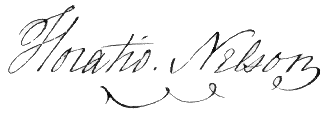
Remembering the Nelson Touch

Lord Nelson who turned 250 last month composed his final act on paper onboard H.M.S. Victory in the early morning hours before the Battle of Trafalgar, 21st October 1805:

HoratioNelson1May the Great God, whom I worship, grant to my Country, and for the benefit of Europe in general, a great and glorious Victory; and may no misconduct in any one tarnish it; and may humanity after Victory be the predominant feature in the British Fleet. For myself, individually, I commit my life to Him who made me, and may his blessing light upon my endeavours for serving my Country faithfully. To Him I resign myself and the just cause which is entrusted to me to defend. Amen. Amen. Amen.


Read the full article >>

Thursday, 3 July 2008

A Whiff of the Grand Home Fleet

Fade Britannia? It may not be a return of the Grand Home Fleet to the briny ocean toss, but the massive 65,000-ton super-carriers, the future HMS Queen Elizabeth and the HMS Prince of Wales, promise to give Britain and its Royal Navy a highly potent platform far from home in the decades to come.

ark_royal_pompey_hrThe two new carriers will be more than three times the size of the Royal Navy's current flagship, the 20,000-ton Invincible-class light carrier, HMS Ark Royal

All in all, good news to swell loyal hearts. Mind you, this little perfidious trick by the French is politically designed to make them the property of the European Union. Can you just imagine a fully complemented French crew sailing in the Queen Elizabeth!


Read the full article >>

Monday, 2 June 2008

Prince William Joins the Senior Service

Sub-Lieutenant William Wales entered the Royal Navy today and will serve in HMS Iron Duke after undergoing three weeks of basic training, the latest stage in a military career that has seen him deployed in all three Armed Services.

APTOPIX BRITAIN  PRINCE WILLIAMRear Admiral Bob Cooling, Assistant Chief of the Naval Staff, said yesterday that William’s attachment would be rigorous and challenging, and he spoke with pride about the Prince joining Iron Duke to patrol the waters of the Caribbean for cocaine drug smugglers. The Rear Admiral said:

"It will be a thrill and privilege – not a pain in the ass – for the ship’s company. If we treated him like some super-VIP and tailored a programme for him and walked around on eggshells, then it would be difficult. But he is going to come in just like any other young officer and do all the things young officers get involved in. As far as the training goes, it’s very rigorous. We don’t have passengers out in warships for obvious reasons and he will need to be able to pull his weight in an emergency. The Royal Navy in general, and HMS Iron Duke in particular, are very much looking forward to having this opportunity to show our future King what we do."


Read the full article >>

Sunday, 1 June 2008

The Glorious First of June

The_%27Defence%27_at_the_Battle_of_the_First_of_June%2C_1794When the haze lifted on 1 June 1794, Admiral Howe's fleet engaged the navy of Revolutionary France for the first time in what became the largest sea battle in the French Revolutionary Wars. Although it was henceforth decreed by the Royal Navy that the First of June would forever be 'Glorious', it was not a decisive victory since the French loss of seven ships was mitigated by the fact that their grain convoys from America to France made their destination, thus preventing an outbreak of famine in the Revolutionary Republic.

It is interesting to note that the Naval General Service Medal was a campaign medal approved in 1847, for issue to officers and men of the Royal Navy and was retrospectively awarded for various naval actions during the period 1793 to 1840, provided the applicant for the medal was a surviving claimant. One surprising claimant was 54-year-old Daniel Tremendous McKenzie, who had been born during the battle of the Glorious 1st of June on board HMS Tremendous, and was duly awarded the medal 54 years later for a battle fought on the day he was born!

Which brings me to the expression "son of a gun". This came about during the Age of Sail when ladies such as Mrs McKenzie were in transit on His Majesty's ships and needed to give birth, the only place available was to have a part of the gun deck between two cannons, screened off, for the birth to take place, hence the expression:- "son of a gun". Now you know.


Read the full article >>

Friday, 23 May 2008

Why H.M.S. Trafalgar Ran Aground

As a former naval officer with the 'Royal' Canadian Navy, this surprised me. According to the findings of an inquiry released yesterday, a British nuclear attack submarine crashed, hit the seabed, injuring three crewmen, during a training exercise in November 2002 - causing £5million worth of damage - because its navigators covered their charts with tracing paper in order to protect them from damage.

article-1021173-007ABF3D00000258-589_468x343Submarine commanders Robert Fancy, right, and Ian McGhie, rear left, at their 2004 court martial over the crash

I'm surprised by this because our longstanding naval practice has always been to plot the warships' course directly on the chart itself, and then to erase the pencil tracks afterwards for future reuse. Overlaying tracing paper could indeed obscure vital navigational details, or just be a plain nuisance, as it's difficult enough to see the chart's contours as it is. Constantly plotting track and position, taking visual, radar or satellite fixes, calculating speed through the water based on knots wrung on, strength and direction of current and wind, the busiest guy on the bridge of a ship is the gentleman hovered over the ship's chart. It cannot be overemphasised that navigators, or navigating officers of the watch, need to be able to clearly see what they are doing. The safety of Her Majesty's Ship, to say nothing of a submarine with its added dimension, depends on it. Sheesh, who cares about a few smudge marks on some prestine naval chart - are we that strapped for cash in the Royal Navy, gentlemen? Egad.

trafalgar_20060522154319The HMS Trafalgar, which ran aground during the exercise in 2002

Incidentally, HMS Trafalgar was the first British submarine to fire Tomohawk missiles in a combat theatre of operation, having successfully hit their targets in Afghanistan following 9/11. But there will be no more flying of the Jolly Roger now. The Trafalgar is set to be decommissioned in 2008.


Read the full article >>

Tuesday, 22 April 2008

200 Years: Royal Navy Escort to Rio

200 years ago the Napoleonic plague was spreading like wildfire across Europe. The Royal Navy escorted the Portuguese Court to Rio de Janeiro. An ally was in need for help, and the Royal Navy stood up for her with service.


On March 8, 1808, the Royal Navy escort arrived in Rio de Janeiro with the Portuguese Court, and Rio de Janeiro became the capital of Portugal.


The Portuguese Regent, Dom João, later Dom João VI, sets foot in Rio.


The bicentennary is celebrated this spring.


Read the full article >>