Sixty Joyless De-Britished Uncrowned Commonpoor Years (1949-2009)

Elizabeth II Vice-Regal Saint: Remembering Paul Comtois (1895–1966), Lt.-Governor of Québec
Britannic Inheritance: Britain's proud legacy. What legacy will America leave?
English Debate: Daniel Hannan revels in making mince meat of Gordon Brown
Crazy Canucks: British MP banned from Canada on national security grounds
Happy St. Patrick's: Will Ireland ever return to the Commonwealth?
Voyage Through the Commonwealth: World cruise around the faded bits of pink.
No Queen for the Green: The Green Party of Canada votes to dispense with monarchy.
"Sir Edward Kennedy": The Queen has awarded the senator an honorary Knighthood.
President Obama: Hates Britain, but is keen to meet the Queen?
The Princess Royal: Princess Anne "outstanding" in Australia.
H.M.S. Victory: In 1744, 1000 sailors went down with a cargo of gold.
Queen's Commonwealth: Britain is letting the Commonwealth die.
Justice Kirby: His support for monarchy almost lost him appointment to High Court
Royal Military Academy: Sandhurst abolishes the Apostles' Creed.
Air Marshal Alec Maisner, R.I.P. Half Polish, half German and 100% British.
Cherie Blair: Not a vain, self regarding, shallow thinking viper after all.
Harry Potter: Celebrated rich kid thinks the Royals should not be celebrated
The Royal Jelly: A new king has been coronated, and his subjects are in a merry mood
Victoria Cross: Australian TROOPER MARK DONALDSON awarded the VC
Godless Buses: Royal Navy veteran, Ron Heather, refuses to drive his bus
Labour's Class War: To expunge those with the slightest pretensions to gentility
100 Top English Novels of All Time: The Essential Fictional Library
BIG BEN: Celebrating 150 Years of the Clock Tower
Showing posts with label Crown-in-Parliament. Show all posts

Monday, 2 February 2009

The Peaceable Kingdom

The Canadian political crisis is over with Prime Minister Harper's (awful) budget passing in the Commons today. For the root of political and social tranquility in Canada, we need look no further than the Maple Crown.

Globe and Mail cartoon depicting Prime Minister Stephen Harper as King of the Realm following his success in getting Parliament prorogued, thereby saving his political bacon.

"But even if better practices can be instituted to guide the parliamentary head of state (be it a monarchical or republican model) in determining whether all the possibilities of forming an effective government have been exhausted and that a hung parliament must be dissolved, some element of discretion will remain, and the system’s smooth functioning will depend on the good judgment and honourable behaviour of the key actors."

This statement is just so, and if the Canadian political crisis has taught us anything, it is that we cannot depend on the honour of our parliamentarians to get us out of these types of political messes, for they are the ones who get us into them. In these situations when parliament has become dysfunctional, when no act of parliament can be passed, when there is no mechanism in the written constitution we can defer to, and no judiciary we can turn to, the crisis can only be solved by the neutrality, dignity and independent power of the Crown itself. Indeed, a proclamation issued by the Queen under the discretionary powers of the Royal Prorogative, what AV Dicey called "the remaining portion of the Crown's original authority":


Proclamation Proroguing Parliament to January 26, 2009

ELIZABETH THE SECOND, by the Grace of God of the United Kingdom, Canada and Her other Realms and Territories QUEEN, Head of the Commonwealth, Defender of the Faith. To our Beloved and Faithful Senators of Canada, and the Members elected to serve in the House of Commons of Canada, and to all to whom these Presents may in any way concern,

A PROCLAMATION Whereas We have thought fit, by and with the advice of Our Prime Minister of Canada, to prorogue the present Parliament of Canada; Now know you that, We do for that end publish this Our Royal Proclamation and do hereby prorogue the said Parliament to Monday the twenty-sixth day of January, 2009.

IN TESTIMONY WHEREOF, We have caused this Our Proclamation to be published and the Great Seal of Canada to be hereunto affixed.

WITNESS: Our Right Trusty and Well-beloved Michaëlle Jean, Chancellor and Principal Companion of Our Order of Canada, Chancellor and Commander of Our Order of Military Merit, Chancellor and Commander of Our Order of Merit of the Police Forces, Governor General and Commander-in-Chief of Canada.

AT OUR GOVERNMENT HOUSE, in Our City of Ottawa, this fourth day of December in the year of Our Lord two thousand and eight and in the fifty-seventh year of Our Reign.


Read the full article >>

Sunday, 1 February 2009

Real Sleaze on Slime-Green Benches

The Monarchist reported about eight months ago on the entry of the High Tory Gerald Warner into the pages of the Daily Telegraph, with Is It Just Me?, after the apparent sacking from Scotland on Sunday.

Gerald Warner did have a Scotland on Sunday column at the end of last June, and the Warner column occasionally ran until November. Since November 16, however, whilst blogging at the Daily Telegraph is going strong, Scotland on Sunday has been running a Warner column without exceptions. The column has been revived.

The green benches of ParliamentWrites Gerald Warner this Sunday:

The Lords are more representative than the scoundrels down the corridor

THE controversy over alleged corruption in the House of Lords has provided an excuse for MPs to parade their hypocrisy, clapped-out modernisers to revive the canard of "Lords reform" and commentators to display their consummate ignorance of everything to do with the institution of the peerage.

Clearly, the allegations against the four peers must be investigated and, if well founded, punished. Otherwise, the issue is fogged in spin and stupidity. This is not House of Lords sleaze, any more than l'affaire Jonathan Aitken was described as Commons sleaze: it is Labour sleaze. It is typical of Labour, having ejected hundreds of hereditary peers of impeccable character and replaced them with its own nominees, when the latter sully the reputation of the Upper House to condemn the institution instead of the perpetrators. Sleaze allegations in the Lords are rare: can the same be said of the sanctimonious Commons?
Real sleaze can be found on Parliament's slime-green benches


Read the full article >>

Sunday, 14 December 2008

The Powers of the Crown – Satisfactory?

The so-called crisis in Her Britannic Majesty's Kingdom of Canada has been described as a situation where the choice was between two evils. Either the Governor General had to do as advised – block the popular will as expressed through Parliament, by prorogation – or refuse to do as advised by an elected official.

The Parliamentary Mace of Western Australia
I'll leave the specifics of this situation to others, making more general comments here on the two main issues of principle; whether advice should be automatically heeded or not and whether a parliament should be suspended or not.

Let us have a look at the assertion that advice given must be followed. This is largely based on Walter Bagehot's three rights; the rights to warn, to encourage, and to be consulted. In addition, the case is made for so-called reserve rights, rights only exercised in emergencies, from time to time.

We will examine the assumption that the Crown must remain above politics. There is first of all a difference between being above politics and being above party politics. Also, there is a difference between being above politics and being above day-to-day politics. And perhaps above all, there is a difference between being above and ejected to irrelevance. We need to remember what the preposition above means. It says something about who or what is above whom or what. Being above and being totally sidelined are two very different things. One cannot be above and sidelined at the same time.

We so often hear that the Crown should remain politically neutral. However, there is also the issue of having a check on Parliament, and even on the popular majority. Any balancing act against the will of Parliament or the will of the popular majority will necessarily not be politically neutral. It may be political party neutral, but it will never be politically neutral. You cannot have an office as a check on democracy and politically neutral at the same time. You cannot have your cake and eat it too.

The concept that the Crown must only act upon the advice of elected politicos reduces the Crown to a rubber-stamping machine. If the Crown is to be a rubber-stamping machine, it would be appropriate to ask what the point of monarchy is.

It can be argued that the rights of the monarch are there to prevent the “advisors” from coming with indecent advice. However, if assent is taken for granted, one could wonder if there is any such prevention at all.

Of course, there is the issue of emergencies. If you really have a machine, this machine would consent also in the most severe emergencies, wheras a monarch or its representative may not. It is, however, tempting to ask if we ever will encounter an emergency severe enough for royal intervention to occur. It is more probable that our liberty will continue to be nibbled away, for expedience, and by parts, to paraphrase the great Edmund Burke.

We should have a look at what this month has happened in the Grand Duchy of Luxembourg. The Grand Duke refused to give his assent to a new euthanasia bill. The politicos, headed by the PM, promptly responded that the Grand Duke's role would be changed from assenting or sanctioning to promulgating. The PM was himself opposed to the euthanasia bill, but now a “more important” cause was at stake; the will of Parliament.

From time to time, we hear nice and fancy speeches along the lines that “democracy must be something more than majority rule.” We also hear the talk of constitutional democracy being a form of government where the will of the majority is limited. However, when a real check on the will of Parliament is exercised, that check is debunked, and we hear that nothing may stand in the way of the will of Parliament.

The Parliament in Luxembourg has reportedly acted swiftly. The constitutional amendment was passed reportedly this passed week. It took less than two weeks from the constitutional conflict arose to the politicos had passed the constitutional amendment. We have been told that debate on important issues is something we should allow time for. However, when parliamentary power is threatened there seems to be no limit to how little time there is.

The story in Luxembourg may serve as a scenario for what will happen were the Crown in a Commonwealth Realm ever to intervene in a similar way. Remember though, that scenarios are not certainty. Another scenario is that the Crown continues the policy of total non-intervention for decades – or even for another century and more – and people get even more accustomed to the concept that the Crown is a decoration.

The story in Luxembourg may also serve as an illustration of how far we in this world have come when it comes to unlimited democracy. Nothing must stand in the way of a popularly elected parliament. Nothing must stand in the way of the popular majority. It is sad.

Some people say that the Governor General of Canada did no wrong, but that it was Stephen Harper who gave the wrong advice. Advice is just that, advice. As we have established, it is a sad state of affairs where “advice” becomes verdict – where the Crown is ejected to irrelevance.

Now for the issue of prorogation. Situations do arise when there is a need for a monarch or a viceroy to tell the politicos to pull themselves together. When monarchs or viceroys do this, they are much criticized, but their doing so is still much needed. If parliamentarians decide one thing one week, and then turn around and decide the opposite the next, sending them on leave is perhaps not such a bad idea. We can think of other things also that are not so bad ideas in such a situation either.

Here we take issue though with something a bit beyond merely telling politicos to pull themselves together.

Yours truly often longs for the times when parliaments sat only a few weeks a year, and perhaps they didn't even meet every year. The federal Parliament in Switzerland is still like this, meeting only a few weeks a year.

When people complain about politicos having longer vacations than the regular people, we should respond that it is a good thing with longer vacations for politicos. When they're on vacation, they don't get to pass lots of new legislation.

We should rejoice when a parliament is suspended. There should be more of it. Of course, if Parliament has a secretariat that is not suspended, the suspension isn't as effective as it otherwise might be.

We have grown accustomed to parliaments and other legislatures meeting most of the year.

We should keep in mind what Judge Gideon J. Tucker told us:

No man's life, liberty, or property are safe while the legislature is in session.
The thinkers that warned about the effects of unbridled democracy are many. Amongst them were Sir James Fitzjames Stephen, Alexis de Tocqueville, and W.E.H. Lecky. Edmund Burke wrote of tyrannical democracy. So have many others. When we see that they were right, we should take their warnings seriously.

We have grown accustomed to popularly elected assemblies as always present, and we are told – and most of us believe – that they are guarantors of our freedom. Yet government interferes in our lives, homes, and businesses to an ever increasing level, not to mention to a degree foreign to most – if not all – monarchs of old. As the power of parliaments and legislatures has risen, the power of monarchs has declined. Declined also has our liberty.

We mark this year 320 years since the so-called “Glorious Revolution.” In these 320 years, democracy has far from delivered on its promise of liberty.

The right to vote is what is supposed to protect us. Yet, liberty is nibbled away anyway. We are told that the individual vote gives the individual influence. Yet, no one asserts that an individual right to pour a bucket of water into Lake Superior gives the individual influence.

If parliaments didn't meet so often, if their suspension was not so uncommon, and if the parliamentary will couldn't be taken for granted, it is likely that this world would be a better place.


Read the full article >>

Saturday, 6 December 2008

Friday, 5 December 2008

Why the Governor General was right.

It’s over: the day, the decision, the crisis, the coalition, and Stephane Dion’s leadership. After the abortive putsch — constitutional as it may have been — the field is strewn with bodies, and the bloodletting has just begun.
- Andrew Coyne on the end of the crisis, the Governor General's decision and the impending death of the Coalition.

I applaud the Governor General and her wise counsel on her decision to prorogue Parliament and to give its Members a badly needed time-out. In my judgement, she picked the least worst of two very bad options, and she should be commended for doing what was required to defend the neutrality and dignity of her office. Make no mistake about it, on the face of it this sets an awful precedent, of backing a prime minister and his ministry on the run from the will of Parliament. But she demonstrated considerable prudence - perhaps even courage - for the following reasons:

1. Parliament expressed a degree of confidence in the Conservative government when it passed the Throne Speech last week. I say again, last week.

2. The current government was elected seven weeks ago with a stronger minority. In a five party/leader race, Stephen Harper won 143 of 308 seats and 37% of the vote, compared to just 77 seats and 26% of the vote for Stephane Dion's Liberals. The Liberal leader received no mandate to be prime minister.

3. Granted you should never govern based on polls, but there are polls and then there are polls. Polls now indicate that had it been a two leader race, one between Harper's Conservatives and a Dion led coalition of the Left, the Conservatives would have won a comfortable majority of the seats with a commanding 20 point lead in the popular vote, something like 47% to 24%. Canadians do not like it.

4. Had the GG thrown out the Conservatives and installed the rickety Coalition in government, the populace would have goaded for her removal or even worse, brought our whole parliamentary monarchy into disrepute.

5. The GG showed a small degree of courage in her home province of Quebec by not handing a share of power to the Bloc Quebecois. Although she stands to gain by completely dispelling any notion that she's in league with the Quebec sovereigntists (an issue that came up just prior to her appointment by the Queen), this will not be a popular move in much of la belle province.

6. Granting power to the Coalition would have fanned the flames of national disunity. It would have pitted Quebec against the rest of Canada, especially Western Canada.

7. Removing the Conservatives from power would have enraged the West. I'm not talking about anger here, I'm talking spiteful, seething and spitting rage.

8. The Coalition is an inherently unstable and factionous thing led by an unusually weak leader, who may have not lasted past Christmas. The Coalition is deeply unpopular with the country partly because it appears like a naked grab for power so soon after an election. Having installed such a fragile edifice, the Governor General would have received a share of the inevitable blame that would arise as a result of the Coalition's failure to properly and responsibly govern the nation.

9. The Conservatives will still have to face the music in January, only this time on a more substantive issue, like the expected federal budget. If they lose the confidence of the House then, the Coalition should be given an opportunity to govern. This is not a cop-out, it's a time-out. A badly needed time-out.

10. As a result of all of the above, few are questioning the political neutrality of the Crown. Our Queen has been saved. God Save The Queen.

Update: Andrew Coyne says it better than I can on the merciful death of the Coalition


Read the full article >>

Sunday, 30 November 2008

The Imperial State Crown

Her Majesty the Queen gives a talk on the Imperial State Crown.


Read the full article >>

Monday, 28 July 2008

Dismissal? Case Dismissed!

An Oxford Professor seems to be making an issue out of the fact that the Sovereign can dismiss the Cabinet. This is said to be undemocratic, and it is apparently an argument against the monarchy.

Let us recall what William Edward Hartpole Lecky told us in his Democracy and Liberty:

Of all the forms of government that are possible among mankind, I do not know any which is likely to be worse than the government of a single omnipotent democratic Chamber. It is at least as susceptible as an individual despot to the temptations that grow out of the possession of an uncontrolled power, and it is likely to act with much less sense of responsibility and much less real deliberation. The necessity of making a great decision seldom fails to weigh heavily on a single despot, but when the responsibility is divided among a large assembly, it is greatly attenuated. Every considerable assembly also, as it has been truly said, has at times something of the character of a mob. Men acting in crowds and in public, and amid the passions of conflict and debate, are strangely different from what they are when considering a serious question in the calm seclusion of their cabinets.
Whilst I am not of a kind who thinks one size fits all, I believe that a mixed government monarchy is a good form of government, and that the British monarchy once upon a time was a good implementation of such a mixed government monarchy.

Her Britannic Majesty
There are no absolute guarantees in it. Not in the way it is guaranteed that an apple will fall to the ground if you drop it. However, there is no similar guarantee that privately owned property will be taken better care of than publicly owned property. This notwithstanding, privately owned property tends to be taken better care of than publicly owned property. Similarly, few government systems, if any, have absolute guarantees, but some tend to work better than others.

It is long since we entered the age where, to paraphrase a son-in-law of Edward VII, King Haakon VII of Norway, monarchs are only allowed to poke their noses in their handkerchiefs. The powers of Their Lordships of the United Kingdom were reduced to suspensive veto already in 1911. We live now in the age of government of a single, omnipotent, democratic chamber and its executive committee, the Cabinet.

While the powers of those democratically elected have grown, with the size and reach of government, liberty has decreased. While it needn’t be so, it is so. While who governs and how it is governed are two separate matters, there are tendencies in who governs that influence how it is governed.

Hans-Hermann Hoppe is a Professor at the University of Nevada at Las Vegas and a senior fellow of the Ludwig von Mises Institute. He has contrasted monarchy and democracy as privately and publicly owned government respectively. He says:
The Whig theory of history, according to which mankind marches continually forward toward ever higher levels of progress, is incorrect. From the viewpoint of those who prefer less exploitation over more and who value farsightedness and individual responsibility above shortsightedness and irresponsibility, the historic transition from monarchy to democracy represents not progress but civilizational decline.
While there is nothing to guarantee that you will buy something when that something’s price goes down, demand tends to increase when prices fall.

While there is nothing that guarantees that a temporary caretaker will do worse than a permanent owner, there are tendencies that make it so in general. While there is nothing to guarantee that a system where one can buy votes through offering “welfare” for other people’s money will give an ever growing “welfare” state, there are tendencies that make it so in general. While there is nothing to guarantee that a system where “anyone can be President” will have the worst demagogues rise to the top, there are tendencies that make it so in general.

While the enlightened monarchy may be the best government, there is no guarantee that he is enlightened.

While we have been warned by thinkers and philosophers of an oppressive majority being worse than an oppressive minority, history too has recorded excesses of monarchs.

It is thus fully understandable that monarchical absolutism was reacted against (no endorsement of outright revolution given). Medication was given, but the problem that the medicine was meant to remedy is long gone, and we see the side effects of that medication. These side effects have proven to be worse than what was meant to be remedied.

The late and great Austrian monarchist Erik von Kuehnelt-Leddihn told us:
There are totalitarian and monolithic tendencies inherent in democracy that are not present even in a so-called absolute monarchy, much less so in a mixed government which, without exaggeration, can be called the great Western tradition.
The British system was once upon a time such a mixed government. Today’s “mixed government” is a mere shadow of what it once was. There are those who believe that today’s system is well balanced of the “three estates.” It is tempting – with all due respect – to ask how many decades they have been on the moon.

The French Baron of Montesquieu modeled his constitutional monarchy on the British model. Montesquieu’s model of constitutional monarchy gave considerable more powers to the monarch than Walter Bagehot’s rights to warn, encourage, and be consulted. Montesquieu’s model was a mix of monarchy, democracy, and aristocracy.

We are told that if the Sovereign can dismiss the Cabinet, that is undemocratic. It is not how it should be done in a democracy. We need no more justification? What the people want is right? You don’t even have to say it? It’s implicit? Might makes right?

What about bureaucracy and the modern managerial state with its “welfare” etc.? In many ways people are less free today than in the regimes that the world knew prior to World War I. Do we just say: it’s democratic, that’s how it should be done in a democracy?

What about war? If the people or the popular representatives want to go to war, and that costs millions of lives, do we just say: it’s democratic, that’s how it should be done in a democracy?

What about Hitler? If the people want him in power, do we just say: it’s democratic, that’s how it should be done in a democracy?

Hitler was put in power by a democratically elected Parliament.

Today is July 28. It is the 94th anniversary of the Austro-Hungarian declaration of war on the Kingdom of Serbia. Let’s say His Britannic Majesty had been convinced to dismiss the Cabinet in 1913, the year before that fateful summer of 1914 that was to turn the world upside down.

Now, I am not too optimistic about what the opposition would have done differently if in power, but it is quite clear that a rather different policy in Whitehall and Westminster in July and August of 1914 probably in the long run would have been better for the British Empire and the world.

The most radically different policy would arguably have been not to intervene. Barring non-intervention, refusing to help President Wilson in his crusade to “make the world safe for democracy” by contributing to pushing the Old European Order out would have been another helpful alternative option.

But if a Liberal government with its policies is what the people wanted, we should just say it’s democratic, and that’s how it should be done in a democracy?

H.L. Mencken told us:
Democracy is the theory that the common people know what they want, and deserve to get it good and hard.
It has been said that in a democracy the people get what they deserve. It would be more precise to say that in a democracy the people get what the majority deserves.

While the history of the rule of kings suggests that kings should be checked, the history of the 20th century indeed shows that the rule of a single, democratic chamber needs to have at least as many checks – to say the least.

It is said that the vote is a check. It is, however, food for thought which effect is mightier; the proof of support from the masses the votes give, or the one vote in several million one can use to protect one’s liberties.

In this age of democratic absolutism, Royal intervention cannot be expected to happen any time soon. However, locking the vault door and dropping the key to the bottom of the ocean does not sound like a good idea.

It is so often that we hear that the Sovereign should not intervene because it is not democratic, without any supporting arguments. If a case is brought forward that the Sovereign should not have the prerogative to dismiss the Cabinet, arguments must be provided.

Case dismissed!

God save Her Britannic Majesty! Long may she reign!


Read the full article >>

Saturday, 5 July 2008

Westminster's Fiercest Whip

And I can tell you this, you utterly contemptible little shit. On every morning that you wake up for the rest of your life you will be ashamed of what you did last night.

– Chief Government Whip David Margesson in a letter to John Profumo, M.P.* following the Norway Debate, May 1940. Mr. Profumo had the temerity to vote down the government after the military botch at Norway.

If you ever wonder how Neville Chamberlain kept his coalition government going for so long after the spectacular and humiliating failure of Munich, which became devastatingly apparent as early as March 1939, yet the government survived more than a year thereafter, suffering defeat after defeat as the Nazis shook hands with the Soviets and blitzkrieged across Europe, a good deal of credit must go to the Government's Chief Whip, one Henry David Reginald Margesson. David Margesson (1890–1965), a stern disciplinarian, was without a doubt one of the harshest and most effective whips in British Parliamentary history.

Margesson's mission was to stand in the way of Churchill and his small but vociferous band of anti-appeasers. His position was in many ways unprecedented, having the task of keeping in power a grouping composed of the Conservatives, National Labour and two groups of Liberals - the official Liberal Party and the Liberal National Party all behind a single government that sought to stand above partisan politics. With the government as a whole commanding the support of 556 MPs, as opposed to just 58 opposition members, his main task was to ensure that the government stayed together and was able to pass contentious legislation without risking a major breach within the government. In several areas this proved tricky as different sections of the National combination came to denounce areas of government policy, nevertheless Margesson adopted a method of strong disciplinarianism, combined with selective use of patronage and the social effect of ostracism to secure every vote possible.

But things finally came to a head with the debacle of Norway and Leo Amery's morale busting thunderclap to the Commons, pleading for the government to "In the name of God, go!". Even so, Chamberlain still managed to squeak out a win thanks to the hard hitting Margesson, though poor John Profumo (1915-2006) found himself singled out by the man 25 years his senior. Remember, this was no sudden outburst but a deliberately contrived letter, so once more with energy:

And I can tell you this, you utterly contemptible little shit. On every morning that you wake up for the rest of your life you will be ashamed of what you did last night.

Gulp.

Far from being ashamed *, the young MP no doubt considered this to be his finest hour. Although Chamberlain won the vote, days later he would resign given the growing divisiveness his leadership was proving across the country. When Churchill entered 10 Downing he magnanimously kept Margesson in Cabinet, even though he was perhaps the greatest obstacle to the anti-appeasers. Despite his methods of whipping members into line, Margesson remained a much liked individual, with many members expressing personal admiration for him. Away from his duties he was known to be quite sociable and within the parliamentary party few bore him ill. But as whip he was not to be crossed.

* Until he died in 2006, John Profumo, C.B.E. was the last surviving member of that historic 1940 Commons. In the 1960s he was involved in a prostitution scandal, but fully redeemed his character with a life of charity in the forty years that followed.


Read the full article >>

Tuesday, 24 June 2008

Hereditary peers
overwhelmingly rejected the
Lisbon Treaty

The Lisbon Treaty went through because the vast majority of British peers are no longer port-sodden, addicted to field sports and aggressively patriotic.

LordsDivisionby Gerald Warner

Further to my earlier post predicting that the surviving hereditary peers would patriotically vote in the national interest to postpone ratification of the Lisbon Treaty in yesterday's House of Lords debate, the voting lists which have now been published show that my instinct was correct.

Of the 92 hereditary peers still in the upper house, two are excluded from voting as royal household officers: the Duke of Norfolk, as Earl Marshal, and the Marquess of Cholmondeley, as Lord Great Chamberlain.

From the remaining 90, there were 64 who voted yesterday. They divided 50 against ratification of the 'treaty', 14 in favour.

The 50 seeking to defer ratification consisted of 40 Conservatives, nine Cross Benchers and one UKIP peer. The pro-Europeans were made up of six Cross Benchers, four Liberal Democrats and four Labour peers.

It should perhaps be noted, however, that seven hereditary peers who were excluded from the House in 1999 but brought back as working Life Peers also voted for Lisbon.

These were, from the Labour benches, Viscount Chandos and Lords Acton, Berkeley, Grenfell, and Ponsonby of Shulbrede.

There were also two Liberal Democrats: the Earl of Mar and Kellie and Lord Redesdale, clearly not as xenophobic as his predecessor, so hilariously caricatured by his daughter Nancy Mitford.

A similar anomaly is the fact that Lord Selkirk of Douglas, who voted against Lisbon, disclaimed the earldom of Selkirk, though now sitting as a life peer.

Considering their greatly reduced strength, the 50 anti-Treaty hereditaries constituted a disproportionate percentage of the 184 ermined dissenters from Lisbon.

This was a creditable performance by the hereditary aristocracy. It was swamped, however, by New Labour creations, including the noble Lord Watson of Invergowrie who was responsible for the legislation banning hunting in Scotland and later served a prison term for fire-raising in a hotel.

Happily for the interests of the great European ideal, he did not feel too abashed to attend the upper house and vote for his country's further absorption into the Brussels federation. Noblesse oblige.


Read the full article >>

Wednesday, 14 November 2007

The Beast of Bolsover

THE LABOUR MEMBER OF PARLIAMENT for Bolsover (Derbyshire), Dennis Skinner, can be a real amusing albeit nasty piece of work. As an avowed trade unionist and a traditional socialist, he remains rabidly class-based in his politics. His passion, his syntax, his body language, his comportment and dress, embody the style of the classic working class. In a movement now mostly led by middle-class professionals, he sits as the Labour front bench's token proletarian and Ruskin.

His irreverence for monarchy is legendary, having on a number of occasions hurled sarcastic abuse at Her Majesty and her Black Rod from the safety and impunity of his Commons seat. "Pay your taxes", Queen (1992); "Tell her to read the Guardian!" (2000); "Bar the doors" to the Black Rod, Speaker (2003); "Tell the House of Lords to go to hell." (2004); "Has she brought Camilla with her?" (2005); "Is Helen Mirren on standby?" (2006); "Who killed the Harriers?" (2007). As Matthew Parris of The Times puts it, he has "an instinctive ability to interrupt, to wisecrack on the instant and to sustain working class harangues against the establishment."

He gained his sobriquet "the Beast of Bolsover" for his anti-monarchist buffoonery and for falling foul of the procedures of Parliament, many of which are in his view archaic and contemptible. He has been an MP since 1970, and in all that time never once witnessed the State Opening of Parliament or heard the Queen's Speech. The whole idea of the Crown and the Lords offends him deeply, so much so that he can't bear the thought of assembling in the upper chamber with his parliamentary colleagues to open the session. To the amusement of his colleagues, he prefers to pout in the Commons all by his lonesome, while the Queen conducts the ceremonial business of the nation in the Lords. Skipping the day is obviously not an option for this MP; it goes against his proud "working-class" sensibilities and assiduous attendance record.

In addition to never attending the Queen's Address with his parliamentary colleagues for the past 37 years, he has never once been a member of an All-Party Parliamentary Group or travelled with other parliamentarians on political or non-partisan business; apparently never ate alongside parliamentary colleagues in the Commons dining room or drank in the Commons bar. Avoidant personality disorder or antisocial personality disorder or whatever disorder, social ineptitude of any form is a strange malfunction for a professional politician. A misdiagnosed theory perhaps, but a rebel MP on the "Awkward Squad Bench" who is occasionally an entertaining figure of Parliament, he most certainly is. Unfortunately for theatre-goers, he now assumes the role of a 21st century endangered species, along with the rapidly and thankfully receding notion that there still exists such a thing as a "working-class".


Read the full article >>

Thursday, 8 November 2007

CROWN-IN-PARLIAMENT

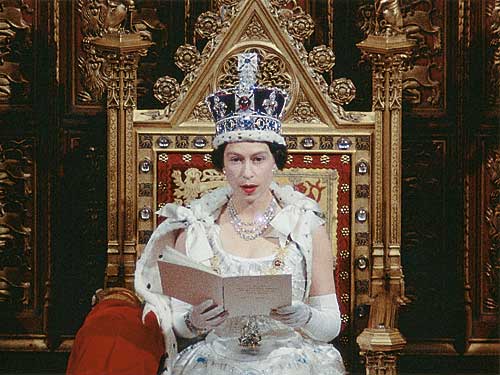
The Imperial State Crown is transported to the Palace of Westminster ahead of the State Opening of Parliament, 6 November 2007.

11am
The actual Queen's speech is scheduled for 11.30am (and for all the pomp and circumstance, it's actually very brief. The emargoed advance copy released to journalists only covers two pages and will barely take 10 minutes to read aloud. Of course, the Queen's copy is actually written on goat skin).

However, already the House of Lords is filling up with peers in their red plumage. Baroness Thatcher shares a joke with Lord McNally.

The prime minister, Gordon Brown, has just left Downing Street in his armoured Jaguar to attend the occasion. As well as this being Gordon Brown's first Queen's speech as prime minister, it has an added irony if within it, there is a bill to remove the remaining hereditary peers from the House of Lords. Some of the red-robed peers now seated in the upper chamber may metaphorically be turkeys waiting for Christmas. We pray this will not be the case.

11.03am
First sighting of Her Majesty. Drawn by six grey horses, the Queen and Prince Philip have just emerged from Buckingham Palace.

The Queen has now arrived at the sovereign's entrance of the royal palace of Westminster.

Looking like something from a fairytale, she enters the House of Lords wearing a diamond and pearl encrusted crown...

...which is soon replaced by the purple pomp of the Imperial State Crown.

11.15am
According to the TV commentary, the Princess Royal is in the royal procession, in her official role as "gold stick in waiting".

11.20am
MPs are gathered in the central lobby. The etiquette is that the frontbenchers at least walk into the Lords chamber together in pairs, like Noah's Ark. So Gordon Brown will be shoulder to shoulder with David Cameron, followed by the Chancellor of the Exchequor and his equivalent critic, and so on and so on. By tradition, MPs crowd into the Lords chamber to hear the speech. And, by tradition, the republican Labour backbencher Dennis Skinner remains in his seat in the Commons and shouts abuse at the monarch.

Meanwhile, Black Rod begins his procession up to the door of the Lords chamber - which is slammed in his face. He strikes it three times, and is permitted entry. He requests MPs follow him into the Lords chamber where the Queen is awaiting them.

11.30am
The Queen, hand in hand with her husband, has arrived in the Lords chamber, and the pair are seated on the golden thrones. "Pray be seated," she tells the peers.

11.40am
The action has switched to the Lords, where MPs now crowd into the small amount of standing space around the entrance. Gordon Brown, perhaps conscious the cameras are on him, is chatting and laughing amicably with other MPs. The lord chancellor, Lord Falconer, presents the Queen with her copy of the speech, known more formally as Her Majesty's Most Gracious Speech or Gracious Address.

"My Lords and Members of the House of Commons,

"My Government's central priority is to seek first the kingdom of God and His righteousness, knowing that all else, including economic prosperity and social stability, will be added. "To this end, my Government will honour my Coronation Oath, which was to maintain the laws of God and the True Profession of the Gospel. They will follow the precepts of the Holy Bible, which was given to me to be the rule for my whole life and Government. "My Government will legislate in humility, recognising that God makes the law, not fallible human beings...(you're a better person than I if you feel the need to replace the above with the actual speech)
11.50am
The monarch departs. The Speaker of the Commons plods back to the Commons chamber. MPs, chatting across the party lines, troop back in behind him.

The actual debate on the Queen's Speech, opened by Mr. Brown and Mr. Cameron, begins in the Commons at 2.30pm.


Read the full article >>

Wednesday, 17 October 2007

Where's your morning suit, Mr. Harper?

SPEECHES FROM THE THRONE, like yesterday's opening of the Canadian Parliament, are important and prestigious state occasions, and as such deserve the pomp and ceremony traditionally associated with them. Ideally this means that the Queen, if present, is enthroned and crowned; the Governor-General is vice-regally sashed in the Windsor uniform; that chief justices of the Supreme Court are wigged and gowned (though sadly in Canada's case, no longer wigged); that speakers and clerks are robed with bar jackets, and bicorned or tricorned as the case may be; it means the Sergeant-at-Arms is adorned with the custody of the ceremonial mace; that military officers are smartly decked out in all their glory and honour: medals, scabbards, swords and all; and the sitting Prime Minister, the first gentleman of Parliament, is formally dressed in his best morning suit.

I can't remember when the last time a Prime Minister wore morning dress. Mackenzie King was the last to wear a frock coat and top hat. Diefenbaker certainly wore his morning suit, as did Pearson and Trudeau after him. If you didn't wear it at every Throne Speech, you certainly did following your first election as Prime Minister, and you certainly did if the Queen was in attendance. But 1977 was the last time the Queen sat on the Canadian Throne (see below, Prime Minister Trudeau wears morning dress with signature rose). Alas, the tradition of the morning coat has given way to a miserly political culture that is always at pains to demonstrate its frugality. Haute couture for the politician is to be avoided at all costs. For them, the imperative is "business as usual".

But state occasions are not "business as usual". They are supposed to be lavish affairs, their purpose and intent being to lift us up from the drudgery of administration, and to remind us that there is something at play here that is greater than our own petty and lilliputian concerns as taxpayers. Prime Minister Harper understands this, which is why yesterday's Speech from the Throne was godly in its invocation: "May your deliberations be guided by Devine Providence, may your wisdom and patriotism enlarge the prosperity of the country and promote in every way the well-being of its people." This is evidence that we still believe in the function of God, and His supremacy over all events throughout our history. But if God, King and Country are all in the room, the least Harper could do is dress for the part.

(Above/below: Prime Minister's Chretien and Martin dress the part in 2000/2004)


Read the full article >>

Wednesday, 10 October 2007

Yes to 'First-Past-The-Post' at Queen's Park

WILL UPPER CANADA GO THE WAY OF NEW ZEALAND? Twelve million Ontarians will decide today whether they will stick with the time-tested British style First-Past-the-Post (FPP) plurality form of democracy, or go with Mixed-Member-Proportionality (MMP), a watered down variant of proportional representation. Today's referendum is asking us whether we should continue purely with FPP, whereby local Members of Provincial Parliament are elected to Queen's Park under a winner take all scenario, or go with a hybrid system that parachutes one-third of the members into the legislature according to lists drawn up by the parties in advance, to be apportioned according to each party's percentage of the popular vote, taking into account how many local members each party got elected under FPP.

And to that I uncategorically say thanks, but no thanks. As David Warren reminds us, "the genius of first-past-the-post, over the centuries, has been its ability to eliminate sectarian, fringe, and fruitcake parties. By contrast it favours large, broad parties within which the interests of diverse constituencies have had to be hashed out. This is the citizen's best guarantee against tails wagging dogs." It's also our best guarantee against the introduction of unaccountable politicians, who would answer to their parties, and not to local constituents. Now I know that's largely the case now, where members are whipped by their parties into voting a certain way, but at least the member has to take into consideration the wishes of the electorate; at least the option exists for the member to resign, abstain or vote against the party's position or government on a point of principle; at least we have the ability to get rid of members who don't; and at least we have the ability to kick out the undesirable and those who are unworthy of our trust. Not so under MMP. Top listed candidates in large parties would be permanently shielded against voter wrath.

Also, say goodbye to majority governments. New Zealand hasn't had one since they introduced MMP in the early 1990s. The Kiwis have experienced a proliferation of political parties from two to eight, including the recent introduction of the completely indigenous-based Māori Party. I wonder how representative of the population their lists are: Big Māori, little Māori. Young Māori, old Māori. Female Māori, male Māori. Gay Māori, straight Māori. Māori, Māori, Māori. Māori. And I wonder what a coalition with the Māoris will yield for the non-Māoris. Not a lot, would be my hunch. Would it be possible for Ontario's First Nations to organize themselves in such a way? The possibilities are intriguing.

Certainly we can expect a Toronto Party given that Greater Toronto represents nearly 50% of the population. It shouldn't be too taxing for us to get the minimum 3% required to send in list members. Hell, I might even support such a thing. The point is FPP is our best weapon against special interest groups, and self-interested one man shows like Winston Peters of New Zealand First. He happens to be their Foreign Minister, yet bizarrely remains outside of Cabinet. New Zealand Labour requires his support to continue governing, so Prime Minister Helen Clark has concocted this strange arrangement that requires Mr. Peters to report to her but not to Cabinet. That's MMP in action for you. Forgive me if I don't like what I see.

Update: FPP takes it by 62% to 38%. Not even close. On the down side, the Tories lost the election. Badly. The Tory leader, John Tory (yes, that's his real name), wore his dunce cap in the campaign by promising public funding to all faith-based schools in the province, not just catholic ones, to the obvious horror of secularists. No doubt many were thinking, including many conservatives were thinking: you mean you're proposing to fund Islamic schools? From that moment, the election was over. All the integrity in the world won't save you if you manage to scare the public. I dearly hope Mr. Tory has learned his lesson.


Read the full article >>

Saturday, 30 June 2007

Ten Years after the Handover

Ten years ago today Britain handed back Hong Kong, after 155 of proud rule, to, as Prince Charles described them, "appalling old waxworks" in an "awful Soviet-style display" of Chinese troops "goose-stepping" at the ceremony.

Britain has much to be proud of what they handed back; think of all the countless lives saved in the last century alone when millions upon millions of Chinese were killed by the madness of Mao during the Great Leap Backward, the insanity of the Cultural Revolution, the man-made famines and the ideological warfare that destroyed more of China than all the foreign armies in its history ever did.

And with more and more rights are being stripped away by the communist regime with the government declaring "We are against the anarchic call for 'democracy for all', and against anybody placing his own will above that of the collective," let us take this time to mourn what was lost but at the same time remember our former Commonwealth cousins; When Beijing makes statements like this, it's clear the situation will not get better.

Nevertheless, vestiges of Empire remain as seen from a quick glance of a city map- streets are still for the most part have names such as Prince Edward Road and Wellington Street. Colonial-era buildings and monuments still hold prominent spots -a statue of Queen Victoria remains in Victoria park not far from Victoria harbour.

Hong Kongers still remain deeply proud of the institutions the British bequeathed them from the judiciary with their English-style wigs and rule of law to its clean and open civil service - factors that continue to distinguish the city and give her an edge over her Chinese counterparts. Hong Kong remains Britain's third biggest trading partner in Asia with 3.6 million British passport holders and over 1,000 British businesses remaining.

Detective Chief Inspector Dave Williams who happens to be a British policeman in Hong Kong and one of just 200 or so expatriates still left in a force widely known as "Asia's finest", is a living example of Britain's legacy a decade after: "People are still surprised when they come to Hong Kong, that they find there are expatriate police officers roaming the streets. I think that really adds to the international image of Hong Kong." Once the last expat officer retires in 2028, he admits "It will be the end of an era ... any expatriate influence or the colonial past will be well and truly gone by that stage, there'll be nothing left of us."

Some symbols of Empire remain... Pediment of the Legislative Council building The King George V postbox that was once here has now been replaced A Victoria Regina postbox


Read the full article >>

Thursday, 8 March 2007

Whither the Lords

They would have us elect the Lord God Almighty if they thought they could get away with it. Dear Lord and Father of mankind, forgive our foolish ways; reclothe us in our rightful mind, in purer lives thy service find, in deeper reverence, praise...

The long ascendency of democracy is reaching its zenith, and with it will come the final purge of the nobility, reflecting the triumph of modernist legitimacy and merit over the ancien regime notions of hereditary rights, privilege and honour. Even today, the ancient House of Lords Spiritual and Temporal remains the most distinguished body of collective human achievement and wisdom anywhere in the world, despite the corrupting handywork of "cash for peerages" Tony and his like-minded predecessors. It is lamentable that with an 80% or 100% elected Lords the quality of that great chamber will surely decline, and become beholden to special interests, opinion polls and spin doctoring in the process.

Gone will be the independence and wise countenance of the last of the great noble gentlemen. In its place will come the grandstanding, power grubbing politicians and all their loathsome baggage. Having destroyed the Second Estate and all of its inherited glory, they will now surely feast their eyes on the First.

UpperHouseDate: Ben Russell writing in The Independent, manages to smear the entire noble history of the Lords by citing eight ignoble examples over a 1,000 year period. I could come up with eight examples from the House of Commons this year alone! Loathsome, worthless degenerate!


Read the full article >>

Statement of Concern

The Government of the Dominion of British West Florida is gravely concerned by the continued erosion of the Constitutional Framework in Her Majesty's United Kingdom of Great Britain and Northern Ireland.

We do not lightly take the step of publicly announcing our concerns. It is from our great love and respect that we feel ourselves constrained to speak. The Tradition of the British Peoples, at home, and in Her Dominions across the sea, has always acknowledged the need for a 'mixed' form of governance. The Sovereign, the Lords, and the Commons. This Style of Governance, was in time past responsible for the greatest expansion of Liberty and Wealth the world has ever known. It should not be lightly tossed into the rubbish-bin of History.

The real destroyer of the liberties of the people is he who spreads among them bounties, donations and benefits. - Plutarch

The House of Commons in the United Kingdom, having gone down the road of bounties, donations, and benefits to its natural end, has determined to rid itself of the Peers. They are not seeking 'balance' nor liberty. They seek instead to remove those who would stand against them in the destruction of what remains of the Individual's rights and responsibilities. The Hereditary Lords, owing no allegiance to the Commons, and being more resistant to the 'benefits, bounties, and donations' of the Government (funded of course by the tax-payers), are not being removed because they have impeded the expansion of Liberty, nor Justice, nor even Wealth.

The House of Commons, having felt now the power of 'Parliamentary Supremacy' these many years is intent on the elimination of all who would raise a voice against the politically motived actions of the wealthy, and powerful Members of Parliament. These people bring no greater qualifications to office than that of effectively marketing themselves as a product for the voting consumer.

We can not sit in silence as the Mother of Parliaments is strangled by the hands of her own Commons. What all the enemies of the British People have never been able to accomplish: The destruction of her Ancient and Honourable form of Government. This House of Commons has now set about to complete.

May God have mercy on the souls of these people, some of whom act from the sincerest of hearts. May God grant Wisdom and bring this House of Commons to its senses. May God Save the Queen and Her Parliament from the intentions of this current House of Commons.

Robert, Duke of Florida, Lord of St. George, GSB
Her Majesty's Governor-General in and for the
Dominion of British West Florida.


Read the full article >>

Thursday, 11 January 2007

“Republic of Ireland” to Lose English Monarchy, Repeal Three Thousand Laws, Obliterate a Thousand Years of History

I’m not sure about this, but this could very well be the single largest repealing measure in any state’s history. The Government of Ireland is pursuing a wildly ambitious scorched-earth policy on their legislative books. Because of an unrepealed 1542 law, which makes Henry VIII and his heirs and successors the lawful King of Ireland, ole Danny Boy currently has more than a token claim to the status of a constitutional monarchy. Luckily for republicans, government lawyers are working in overdrive to clear up any confusion.

Some of the laws pre-date the Norman conquest of 1169 as all the laws of England were later transported wholesale to Ireland in 1494 in an effort by King Henry VII to stabilise Ireland.

In 1542, King Henry VIII tried to put the Irish question beyond doubt by having the Irish parliament pass a law declaring him to be the King of Ireland.

In 1962 this law was repealed but research revealed a second law of 1542, which restated and expanded on the first declaring King Henry to be the King of Ireland.


Read the full article >>

Friday, 22 December 2006

There'll Always Be An England, Maybe

Britain finds herself this Christmas in a very sad state indeed. Her Majesty's Home Secretary and a number of other figures have announced that a successful terror attack in Albion is inevitable before the year finishes. An aide to the British commander in Afghanistan has been arrested for spying on behalf of Iran. A murder suspect has fled the country as a fully-covered Islamic female (so clad, authorities didn't dare ascertain his identity). Our Prime Minister is the first in British history to be interviewed by the police whilst in office; and Her Majesty's Government stands splattered about in slime and corruption, no longer even pretending to virtue, but nakedly flouting the law itself. 36% of the British electorate are actively giving up on mainstream British politics. Israelis now advise British subjects on how to live in a nation beset by suicide bombers. Over 200,000 British subjects left the country last year; almost a million have gone since 2000; meanwhile each year half a million Muslims enter. ID cards, speech hate laws, both on the horizon - a quarter of the world's CCTV cameras swivelling atop our lampposts and high-streets - our armed forces cut, cut and cut again.

My friends, Britain is over, or is just about to be. It still feels strangely untouched in places – I type this looking out across a hilly, crisp cold landscape, spotted liberally with trees and the footprints of animals, the sun starting to set, not a cloud about, frost stuck to our path, hot cocoa on the stove, King’s College choir in the CD player, and a long fun night of present-wrapping ahead… and yet, the trap’s been sprung, the net is over us, and all that remains is for the terrible future to haul in its prey.

All offers of invasion from brother nations warmly welcomed. I, for one, would welcome some new Anglosphere over-lords with open arms. A coalition of the willing - John Howard and Stephen Harper leading, appointing an amenable Viceroy in due time - would be Britain's best Christmas present of all. How about it?


Read the full article >>

Wednesday, 20 December 2006

Britain - the new banana republic?

Iain Murray, weighing in at The Corner, believes that Britain is no longer a constitutional monarchy. With the prime minister's unprecedented intervention to save the Saudis from an embarrassing corruption inquiry into a British arms deal, Tony Blair has flagrantly dispensed with the rule of law and turned Britain into (according to Oliver Kramm at The Times) the newest banana republic.

Stephen Pollard explains:

In my view, it's of a different order of magnitude to cash-for-peerages. I'm not diminishing that (if a crime is indeed proven). But the notion that the government can suspend the rule of law when it sees fit, with no comeback or debate, strikes at the very heart of the notion of a constitutional rather than an absolute monarchy. So we now live, in the strict meaning of the phrase, under a despotic government, with the government acting, in the name of the monarch, above the rule of law as laid down by Parliament.


Read the full article >>

Thursday, 14 December 2006

Sovereign Independence

By Cyril Bagin

The Forgotten Milestone

This Monday, December 11 marks the 75th anniversary of the Statute of Westminster, a milestone that is significant and yet forgotten. This law was passed by the Imperial Parliament at Westminster in 1931, forever changing our Empire into the Commonwealth. This is the day that Canada and the other Dominions became fully independent countries.

Most of us are aware of the national importance of the battle at Vimy Ridge and the maturing of Canada’s self-identity during World War I. But few are aware of the developments that occurred following this Great War, including both Canada’s welcome at the diplomatic table and the Imperial discussions which took place in the 1920s. These Imperial Conferences led to an organic development in the British Empire that was legally enacted by this Statute of Westminster. Though it was necessarily an act of the Parliament in the United Kingdom, it was actually a consensus agreed upon by the governments of the United Kingdom and the British Dominions existing at that time.

These Dominions within the Empire included the Dominion of Canada, the Commonwealth of Australia, the Dominion of New Zealand, the Union of South Africa, the Irish Free State and Newfoundland . Each of these, beginning with Canada , achieved internal self-government within the Empire. However, until 1931, the key word was “within”. Each Dominion was more than a mere colony and yet was still connected to the mother country. After 1931, each Dominion legally became an equal to the United Kingdom and fully independent in every way. The best example of the meaning of this change is with the declaration of war. At the start of the First World War, when the United Kingdom declared war automatically the whole Empire was engaged. But at the beginning of the Second World War, Canada independently declared war a week later.

This organic change within the Empire effectively created The Commonwealth that Canada still remains a key member of. These seven countries are thus the founding members of this international organization, which at that time was known as The British Commonwealth of Nations. Though each country was now fully independent, each state chose to remain a constitutional monarchy and to keep the unifying role of the Crown. Political power no longer united these realms; now only common allegiance united these free peoples. When she became our Queen, Elizabeth II also became Head of the Commonwealth and recognized that “The Commonwealth bears no resemblance to the empires of the past. It is an entirely new conception built on the highest qualities of the spirit of man: friendship, loyalty, and the desire for freedom and peace.”

While recognizing the Crown, this Statute significantly changed the role of the monarch. Until 1931, King George V was Canada’s king because he was the King of the United Kingdom and he would take official advice in regard to Canada from both the Canadian and British governments. But, with this legislation, The King became our king independently and also became the first Canadian in international law. In other words, sixteen years before Canadian citizenship was created in 1947, the monarch was legally a Canadian and exercised a Canadian role independent of any other. At the next coronation in 1937, the Coronation Oath was changed and George VI swore to govern each realm according to our own laws and customs. He became King of Canada. This is why Canada would remain a monarchy now even if the United Kingdom ceased to be one.

The Statute of Westminster is one of Canada’s constitutional documents. It affected our parliamentary, governmental and foreign affairs. The Parliament of Canada’s powers were extended so that it had full power to make all laws necessary for state, including those that are extra-territorial. The powers of the British Parliament were limited, so that it could no longer affect the laws of a Dominion unless that Dominion requested and consented to that action. Therefore, because Canadian leaders could not agree on a new constitutional amendment formula, the British Parliament continued to pass amendments to Canada’s constitution until 1982, however only at the request of the Canadian government. This remained a formality, the real decision now being in Canadian hands.

As we prepare for the 140th anniversary of our confederation, all Canadians can pause to remember this 75th anniversary of the day we became fully independent. Hopefully this will also encourage us to further discover the history and identity of our country.

Cyril Bagin is a member of the Fellowship of Catholic Scholars and Canada’s National Historical Society resident in Windsor.


Read the full article >>